Strong Aerospace and Defense momentum supports RTX in Q2 2025 despite tariff pressures
Overview
RTX delivered solid second-quarter 2025 results, reflecting strong organic growth, a robust backlog, and continued operational execution across both its commercial aerospace and defense segments. While short-term headwinds such as tariffs and a temporary work stoppage at Pratt & Whitney impacted cash flow and margins, the company remains on track to meet key strategic and financial targets for the full year.
“We continued our momentum in the second quarter with organic sales and profit growth* across all three segments, including 16 percent commercial aftermarket growth. Our backlog grew to $236 billion, up 15 percent versus prior year, and we secured major awards for our geared turbofan engines and integrated air and missile defense capabilities in the quarter. Our updated outlook reflects strong operational performance in the first half and incorporates our current assessment of the impact of tariffs. We are focused on delivering on the strong growth in our commercial and defense end markets and remain well positioned to drive long term profitable growth”, said RTX Chairman and CEO Chris Calio.
Q2 2025 vs. Q2 2024:
- RTX reported revenue of $21.6bn (+9% YoY), reflecting strong demand in both commercial aerospace and defense, along with growth in OEM volumes and aftermarket services.
- Collins Aerospace generated $7.62bn (+9% YoY) in revenue and $1.25bn (+9% YoY) in adjusted operating profit, driven by strong commercial aftermarket growth.
- Pratt & Whitney reported $7.63bn (+12% YoY) in revenue and $608m (+13% YoY) in adjusted profit, supported by higher GTF engine volumes.
- Raytheon (Defense) recorded $7.00bn (+6% YoY) in revenue and $809m (+14% YoY) in adjusted operating profit, benefiting from increased missile and radar deliveries.
- GAAP net income was $1.66bn, a sharp increase from $111m in Q2 2024, driven by improved operational performance and the absence of prior-year charges.
- GAAP EPS came in at $1.22, including a $0.28 impact from acquisition accounting and $0.06 related to restructuring costs.
- Adjusted EPS reached $1.56 (+11% YoY), rising on the back of higher adjusted operating income across all segments and improved volume leverage.
- Adjusted net income totaled $2.12bn (+12% YoY), highlighting ongoing strength in core business performance.
- Operating cash flow was $0.46bn (-83% YoY), impacted by a four-week labor disruption at Pratt & Whitney and working capital timing.
- Adjusted free cash flow was ($0.1)bn, as expected, due to elevated capital expenditures and inventory positioning.
- The company returned $0.9bn to shareholders during Q2 through dividends and share repurchases, reinforcing the company’s balanced capital deployment strategy.
- Dividend increased by 8%, reflecting confidence in cash flow generation and long-term earnings growth.
- RTX ended the quarter with a total backlog of $236bn (+15% YoY). The commercial aerospace backlog reached $144bn, while defense accounted for $92bn.
- The company secured over 1,000 GTF engine orders during the quarter.
- RTX also booked more than $5bn in missile and radar contracts across global defense programs.
RTX updated its full-year 2025 outlook to reflect strong operational performance in the first half of the year, while also incorporating the anticipated impact of tariffs and adjustments related to recently enacted tax legislation. The company now expects adjusted sales of $84.75bn to $85.5bn, revised upward from the prior range of $83.0bn to $84.0bn. Organic sales growth is projected at 6 to 7 percent, up from the previous estimate of 4 to 6 percent. However, adjusted EPS has been revised slightly downward to $5.80 to $5.95, compared to the prior guidance of $6.00 to $6.15. RTX reaffirmed its free cash flow projection of $7.0bn to $7.5bn, maintaining confidence in its cash generation capacity despite external pressures.
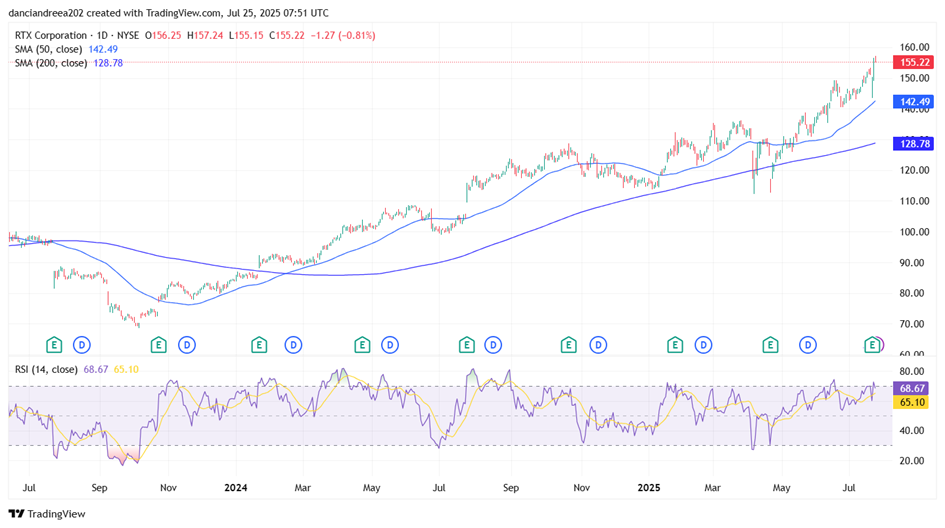
RTX stock maintain a strong upward trend and positioned well above key moving averages. This bullish structure suggests continued medium- to long-term strength, with price momentum supported by both moving averages acting as dynamic support levels. The RSI (14) currently sits at 68.67, approaching overbought territory (70), which may indicate a potential short-term pullback or consolidation phase. Although the stock dipped slightly by 0.81% in the last session, the overall trend remains intact. Key support lies in the $142-$145 range, while a breakout above the $157-$160 resistance zone could trigger a new leg higher.
Author: Ionuț-Adrian Lazar
Discover more from FSEGA Investment Club
Subscribe to get the latest posts sent to your email.