
Boeing reports Q2 2025 results with strong revenue growth and operational progress
Overview
Boeing delivered a strong top-line performance in Q2 2025 as commercial aircraft deliveries accelerated, services revenue grew steadily, and operational improvements supported margin recovery. While the company remains in a net loss position, year-over-year results showed meaningful improvement as production stabilized and backlog execution improved.
CEO Kelly Ortberg emphasized that Boeing is advancing its recovery by focusing on quality, safety, and operational discipline, preparing the company for sustained cash generation in the second half of the year: “Our fundamental changes to strengthen safety and quality are producing improved results as we stabilize our operations and deliver higher quality airplanes, products and services to our customers. As we look to the second half of the year, we remain focused on restoring trust and making continued progress in our recovery while operating in a dynamic global environment.”
Q2 2025 vs. Q2 2024:
- Total revenue was $22.7bn (+35% YoY), driven by higher 737 and 787 deliveries as production ramped up to meet strong demand. The increase also reflects better execution in Global Services and a modest recovery in Defense programs.
- Commercial Airplanes (BCA) revenue increased to $10.9bn (+81% YoY), driven by 150 aircraft deliveries versus 83 in Q2 2024, reflecting stronger 737 MAX and 787 production rates. Operating margin improved to (5.1%), from (11.9%) last year, as higher production volumes and reduced abnormal costs offset ongoing rework and supply chain pressures. The segment secured 455 net orders, including major contracts for 120 787s and 30 777-9s for Qatar Airways, bolstering its multi-year backlog.
- Defense, Space & Security (BDS) revenue rose to $6.6bn (+10% YoY), reflecting steady progress on key programs like T-7A Red Hawk and MQ-25 Stingray. Operating margin improved to 1.7%, compared to (15.2%) in Q2 2024, as the prior-year period was impacted by significant charges on fixed-price development programs. Backlog remained robust at $74bn, with 22% of orders from international customers, providing diversified visibility.
- Global Services (BGS) revenue grew to $5.3bn (+8% YoY), supported by higher demand in maintenance, repair, and overhaul (MRO) services and new contracts for P-8A training and support. Operating margin expanded to 19.9%, up from 17.8% last year, reflecting efficiency gains and strong aftermarket profitability.
- GAAP loss per share improved to $(0.92) from $(2.35) in Q2 2024, largely due to higher volumes and lower abnormal production costs.
- Core loss per share (non-GAAP) was $(1.24), narrowing from $(1.89), reflecting operating improvements even as working capital and production investments weighed on earnings.
- Net loss was $612m, compared to $1.44bn last year, marking a 57% improvement as revenue growth and cost discipline reduced losses.
- Operating cash flow was $227m, a significant recovery from an outflow of $(3.9)bn in Q2 2024, reflecting improved delivery timing and early signs of working capital stabilization.
- Free cash flow (non-GAAP) was $(200)m, slightly negative as inventory build and capital deployment offset gains from higher aircraft deliveries.
- Total backlog stood at $619bn, including more than 5,900 commercial airplanes, ensuring long-term revenue visibility.
Boeing remains focused on stabilizing production, improving cash flow, and executing against its sizable backlog throughout 2025. Management expects revenue and cash generation to improve in the second half of the year as deliveries increase and working capital pressures ease. The 737 program is currently producing 38 aircraft per month, with plans to increase to 42 per month later in 2025 once supply chain conditions allow. The 787 program is at 7 per month, meeting strong demand for widebody aircraft, while other commercial programs remain stable. The defense portfolio continues to recover from prior-year charges, with delivery schedules on T-7A and MQ-25 improving. Global Services is expected to maintain double-digit margins, supported by sustained MRO demand and fleet growth. Although Boeing did not issue formal EPS guidance, management reiterated its commitment to positive free cash flow for full-year 2025, alongside continued debt reduction and liquidity preservation. Long-term priorities remain centered on safety, quality, production stability, and strategic backlog execution to drive sustainable recovery.
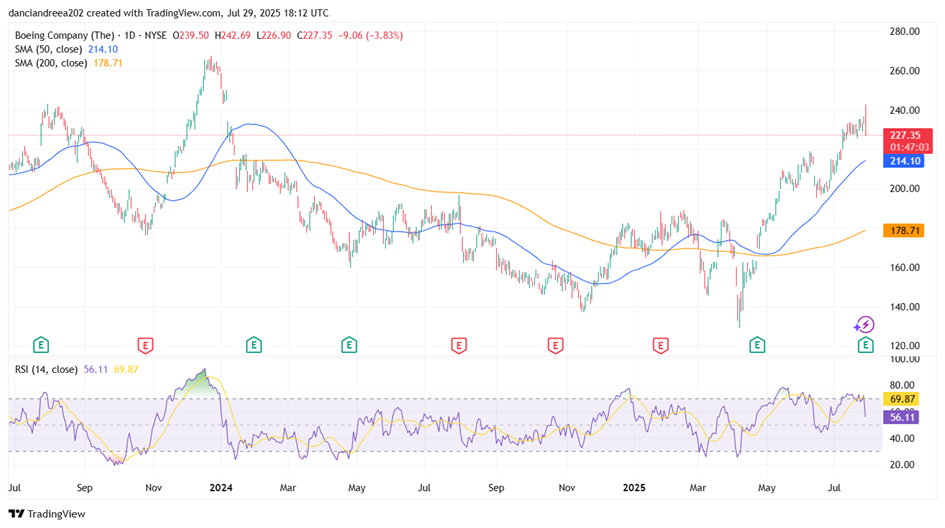
Boeing is trading down 3.83%, after recently reaching multi-month highs. The price remains above both the 50-day SMA ($214.10) and 200-day SMA ($178.71), signaling a bullish medium-term trend, although today’s drop suggests short-term selling pressure. The RSI (14) is at 56.11, moderating from near overbought territory, which indicates that momentum is positive but cooling. Immediate support levels are around $214, aligned with the 50-day SMA, while resistance is near $240-$245, the recent peak. A sustained move below $214 could signal a deeper pullback, while holding this level keeps the uptrend intact.
Author: Andreea-Roxana Danci
Discover more from FSEGA Investment Club
Subscribe to get the latest posts sent to your email.