“Back to Starbucks” strategy driving store growth amid margin pressure in the last quarter
Overview
Starbucks posted Q3 FY2025 results showing modest revenue growth but significant margin contraction, reflecting ongoing investments in its “Back to Starbucks” strategy. EPS was negatively impacted by one-time investments in Leadership Experience 2025 and discrete tax adjustments.
CEO Brian Niccol emphasized the progress in rebuilding operational foundations and preparing for 2026 innovation, with a focus on elevating partner experience and customer service: “We’ve fixed a lot and done the hard work on the hard things to build a strong operating foundation, and based on my experience of turnarounds, we are ahead of schedule. In 2026, we’ll unleash a wave of innovation that fuels growth, elevates customer service, and ensures everyone experiences the very best of Starbucks. We’re building back a better Starbucks experience and a better business”.
Q3 FY2025 vs. Q3 FY2024:
- Total net revenues were $9.46bn (+4% YoY; +3% constant currency), driven by net new stores and international growth.
- North America revenue grew to $6.93bn (+2% YoY), as 5% net new stores offset a -2% comp decline.
- International revenue grew to $2.01bn (+9% YoY), supported by store expansion and FX benefit; China comps +2% YoY on higher traffic but lower ticket.
- Channel Development revenue was $484m (+10% YoY), led by Global Coffee Alliance growth.
- Global comparable store sales declined -2%, with transactions -2% and ticket +1%.
- U.S. comparable sales also decreased -2% YoY, driven by -4% transactions, partially offset by +2% ticket growth.
- GAAP operating income declined to only $936m (-38% YoY), with margin of 9.9% (-680bps), pressured by labor investments, deleverage, and inflation. In the same way, non-GAAP operating income was $956m (-37% YoY), with margin of 10.1% (-660bps).
- GAAP net income also declined to $558m (-47% YoY), reflecting lower margins and discrete tax items.
- GAAP EPS recorded a value of $0.49 (-47% YoY), while non-GAAP EPS was $0.50 (-46% YoY).
- Operating expenses increased to $8.58bn (+12% YoY), primarily higher store labor, G&A, and depreciation tied to store growth.
- Operating cash flow (YTD) decreased to $3.37bn (-26% YoY), impacted by higher inventory and partner investments.
- CapEx reached to $1.85bn, supporting new store openings and renovations.
- Cash & equivalents were $4.17bn, up from $3.29bn at year-end FY2024.
- The company returned dividends of $0.61/share (61st consecutive quarter), totaled $2.08bn cash returned YTD.
- Starbucks added 308 net new stores, reaching 41,097 locations globally, with U.S. and China now 61% of the portfolio.
- Also, the company hosted Leadership Experience 2025, aligning 14,000 coffeehouse leaders on operational excellence and partner development.
- Finally, the company successfully issued $1.75bn in bonds to refinance debt and enhance liquidity.
Starbucks expects a gradual improvement in performance as its “Back to Starbucks” strategy delivers stronger partner engagement and operational efficiency. The company anticipates continued pressure on operating margins in the near term due to labor and reinvestment, but store growth and improved transaction trends in North America and China are expected to support a recovery into FY2026. Management remains focused on driving sustainable long-term growth through new store expansion, operational streamlining, and enhancing the Starbucks Experience, while maintaining disciplined capital allocation and shareholder returns.
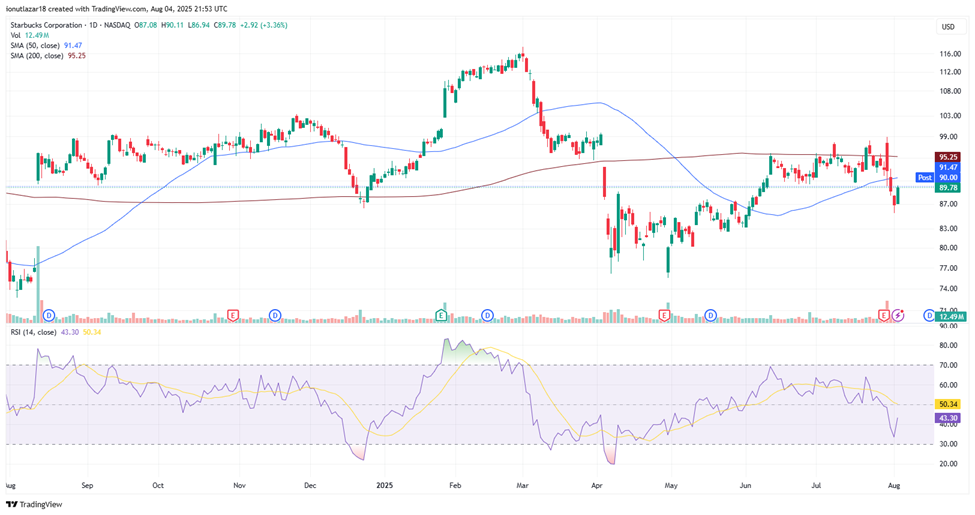
Although Starbucks recently reported its financial results, initial investor reaction was negative, with shares falling sharply at the end of last week, resulting in a loss of -3.88% over the past five days. However, with the start of the first trading week of August, shares have rebounded +3.36%, moving in line with the general market movement. Currently, the price is holding below the 200-day moving average and slightly below the 50-day SMA, and the RSI, although recently dipping into the oversold zone, is starting to show signs of stabilization.
Author: Ionuț-Adrian Lazar
Discover more from FSEGA Investment Club
Subscribe to get the latest posts sent to your email.