
Adidas kicks off 2025 with strong growth across all segments

Overview
Adidas delivered a strong performance in the first quarter of 2025, beating expectations with double-digit growth across all regions and channels. The company’s results reflect the momentum of its core brand and effective execution across both lifestyle and performance categories.
CEO Bjørn Gulden commented: “I am very proud of what our team achieved in Q1. Double-digit growth across all markets and channels in today’s volatile environment shows the strength of our brand and underlines the great job our people are doing. In a ‘normal world’ with this strong quarter, the strong order book and in general a very positive attitude towards Adidas, we would have increased our outlook for the full year both for revenues and operating profit. The uncertainty regarding the US tariffs has currently put a stop to this. Although we had already reduced the China exports to the US to a minimum, we are somewhat exposed to those currently very high tariffs. What is even worse for us is the general increase in US tariffs from all other countries of origin. Since we currently cannot produce almost any of our products in the US, these higher tariffs will eventually cause higher costs for all our products for the US market. Given the uncertainty around the negotiations between the US and the different exporting countries, we do not know what the final tariffs will be. Therefore, we cannot make any ‘final’ decisions on what to do.”
Q1 2025 vs. Q1 2024:
- Revenue increased to €6.15bn (+13% YoY currency-neutral, +12.7% reported), led by 17% growth of the Adidas brand and strong performance in all key markets.
- Footwear sales were +17% YoY, driven by strong growth across Originals, Running, Basketball, and Training.
- Apparel sales were +8% YoY, boosted by Originals, Sportswear, and Outdoor performance.
- Accessories were +10% YoY, contributed to broad-based growth across categories.
- Wholesale revenue were +18% YoY, helped by strong sell-through and increased shelf space.
- Own retail (stores) were +13% YoY, double-digit comps across physical stores.
- E-commerce were -3% YoY (but +18% excluding Yeezy) because Yeezy phase-out completed in 2024, while DTC sales up +15% overall.
- All regions showed double-digit growth when excluding Yeezy sales from the prior year: Latin America (+26% YoY), Emerging Markets (+23% YoY), Europe (+14% YoY), Greater China (+13% YoY), Japan/South Korea (+13% YoY), North America (+3% YoY and +13% YoY excluding Yeezy).
- Gross margin was 52.1% (+0.9pp YoY and +1.6pp for adidas brand), supported by lower product and freight costs, and reduced discounting.
- Operating profit rose to €610m (+82% YoY), reflecting strong top-line growth, gross margin expansion and cost leverage.
- Operating margin was 9.9% (vs. 6.2% in Q1 2024), boosted by scale effects and better overhead efficiency.
- Net income from continuing operations recorded a value of €436m (+155% YoY), supported by improved profit margin and lower financial expenses.
- Basic and diluted EPS from continuing operations recorded a value of €2.44 (vs. €0.96 in Q1 2024), reflecting robust earnings growth.
- Inventories were €5.07bn (+15% YoY), aligned with projected growth.
- Cash & equivalents also increased to €1.43bn (+32% YoY).
- Adjusted net borrowings decreased to €4.59B (-7.5% YoY).
- Net leverage ratio improved to 1.6x (from 3.2x in Q1 2024), all of them reflecting healthy balance sheet supports ongoing brand investments and agility in volatile markets.
Adidas reaffirmed its full-year 2025 guidance, projecting high-single-digit currency-neutral sales growth, supported by a stronger and more diversified product pipeline and improved retail partnerships. Operating profit is expected to rise to between €1.7bn and €1.8bn, driven by continued gross margin expansion and leverage on overheads. The outlook excludes any contribution from Yeezy (which generated ~€650m in revenue and ~€200m in profit in 2024) and incorporates heightened uncertainty due to potential U.S. tariff impacts and broader macroeconomic risks.
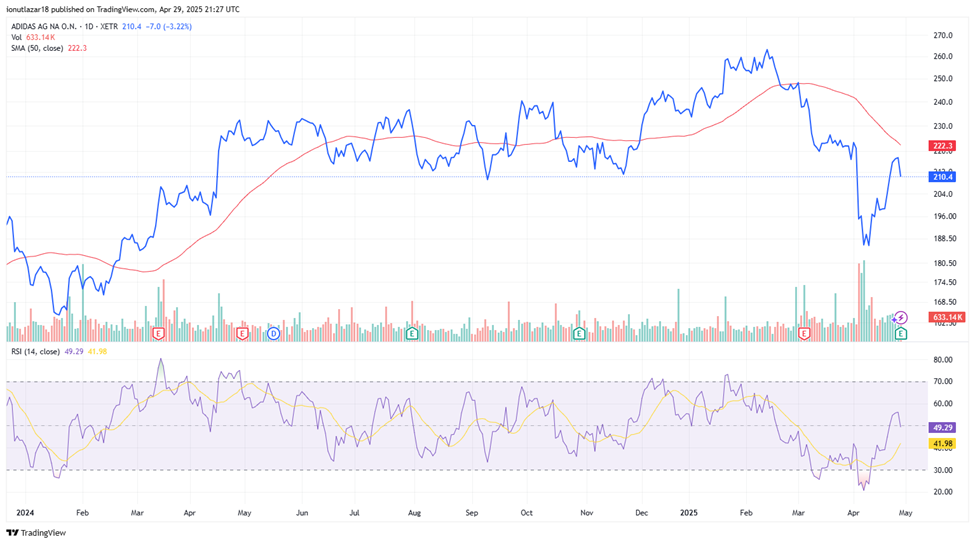
Although the reported results were viewed with great enthusiasm by the company’s management, investors were not so thrilled, with ADS shares seeing a decrease in their stock price on the day the quarterly report was published by over -3%. Also, the downward trend can be observed quite strongly since the beginning of this year, with the stock price of ADS shares decreasing by approximately -11%, still below the 50-day moving average since the beginning of March, amid global uncertainties caused by the imposition of Donald Trump’s trade tariffs.
Author: Ionuț-Adrian Lazar