
AI drives NVIDIA to $44bn in Q1 revenue, despite China setback
Overview
NVIDIA opened its new fiscal year with a strong Q1 FY2026, reporting record quarterly revenue of $44.1bn, up 69% year-over-year and 12% sequentially, driven by unrelenting demand for its AI infrastructure. Despite a significant one-time charge linked to U.S. export restrictions for its H20 chips in China, the company continues to dominate the AI computing space, with data center growth and major global partnerships fueling its momentum.
CEO Jensen Huang said: “Our breakthrough Blackwell NVL72 AI supercomputer — a ‘thinking machine’ designed for reasoning— is now in full-scale production across system makers and cloud service providers. Global demand for NVIDIA’s AI infrastructure is incredibly strong. AI inference token generation has surged tenfold in just one year, and as AI agents become mainstream, the demand for AI computing will accelerate. Countries around the world are recognizing AI as essential infrastructure — just like electricity and the internet — and NVIDIA stands at the center of this profound transformation.”
Q1 FY2026 vs. Q1 FY2025:
- Total revenue rose to $44.1bn (+69% YoY), driven by explosive growth in Data Center segment and surging demand for AI computing solutions.
- Data Center revenue increased to $39.1bn (+73% YoY), led by strong adoption of NVIDIA’s Blackwell platform and global AI infrastructure projects.
- Gaming revenue grew to $3.8bn (+42% YoY), supported by new RTX 50-series launches and sustained demand for AI-powered gaming.
- Professional Visualization revenue was $509m (+19% YoY), supported by new workstation products and enterprise demand for Omniverse-based digitalization tools.
- Automotive and Robotics revenue was $567m (+72% YoY), led by a partnership with GM, new Isaac humanoid robot models, and launch of NVIDIA Halos safety system.
- GAAP gross margin was 60.5% (compared to 78.4% in Q1 FY2025), while non-GAAP gross margin was 61.0% (compared to 78.9% in Q1 FY2025), impacted by a $4.5bn H20-related charge following U.S. export controls.
- GAAP operating expenses increased to $5.0bn (+44% YoY), while non-GAAP operating expenses were $3.6bn (+43% YoY), mainly caused by higher R&D expenses compared to the previous year.
- GAAP net income recorded a value of $18.8bn (+26% YoY), while non-GAAP net income was $19.9bn (+31% YoY), reflecting robust operational leverage even amid inventory write-downs.
- GAAP diluted EPS was $0.76 (vs. $0.60 in Q1 FY2025), while non-GAAP diluted EPS was $0.81 (vs. $0.61 in Q1 FY2025), aided by higher margin product mix and platform scale.
- GAAP net cash provided by operating activities increased to $27.4bn (+79% YoY), supported by higher operating income and strong working capital management.
- Free cash flow was $26.1bn (+75% YoY), enabled aggressive reinvestment and capital return.
- The company had buybacks of $14.1bn in share repurchases during Q1.
- The company also announced a quarterly dividend of $0.01 per share payable July 3, 2025.
NVIDIA expects Q2 FY2026 revenue of $45.0bn (±2%), despite an estimated $8.0bn revenue impact from continued H20 export restrictions to China. GAAP and non-GAAP gross margins are projected at 71.8% and 72.0%, respectively, and are expected to trend toward the mid-70% range by year-end. Operating expenses will rise as NVIDIA continues investing in R&D and global AI infrastructure, but robust demand for AI compute positions the company for continued leadership in a rapidly scaling market.
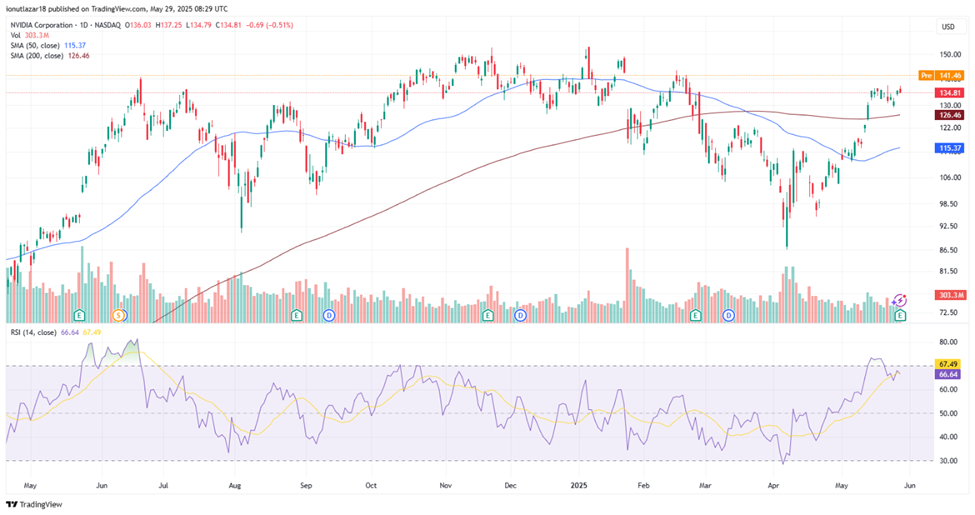
The release of the financial results triggered a strong positive reaction for NVDA stock, reflected in an upward movement of over +5% in the pre-market. From a technical point of view, the stock is overcoming a key resistance area and confirming the continuation of a consolidated uptrend, supported by positioning above the two important moving averages and a rising RSI. A firm close above $140 would validate the breakout, and in this context, the $145-$150 area may become the next target level, while the $130-$132 area would act as a verification support in case of consolidation.
Author: Ionuț-Adrian Lazar