
AMD posts 36% revenue growth and record Q1 profitability
Overview
AMD delivered a strong start to 2025, posting its fourth consecutive quarter of accelerating year-over-year growth and record Q1 profitability.
CEO Dr. Lisa Su stated: “We delivered an outstanding start to 2025 as year-over-year growth accelerated for the fourth consecutive quarter driven by strength in our core businesses and expanding data center and AI momentum. Despite the dynamic macro and regulatory environment, our first quarter results and second quarter outlook highlight the strength of our differentiated product portfolio and consistent execution positioning us well for strong growth in 2025.”
Q1 2025 vs. Q1 2024:
- Total revenue increased to $7.44bn (+36% YoY), driven by strength in Data Center and Client segments.
- Data Center segment revenue was $3.7bn (+57% YoY), primarily driven by growth in AMD EPYC™ CPU and AMD Instinct™ GPU sales.
- Client and Gaming segment revenue was $2.9bn (+28% YoY), with Client revenue of $2.3bn (+68% YoY), primarily driven by strong demand for the latest “Zen 5” AMD Ryzen™ processors and a richer mix. Gaming revenue was $647m (-30% YoY), primarily due to a decrease in semi-custom revenue.
- Embedded segment revenue was $823m (-3% YoY), as demand in end markets remained mixed.
- Gross profit grew to $3.7bn (+46% YoY), with a gross margin of 50% (compared to 47% in Q1 2024).
- Operating expenses increased to $2.9bn (+16% YoY), representing 39% of revenue (compared to 46% in Q1 2024).
- Operating income was on an extremely strong upward trend, reaching the value of $806m (vs. $36m in Q1 2024), while operating margin rose to 11% (compared to 1% in Q1 2024).
- GAAP net income experienced a fabulous growth to the value of $709m (+476% YoY), with GAAP EPS of $0.44 (+529% YoY).
- Non-GAAP net income also grew, but at a much slower pace, to $1.57bn (+55% YoY), while non-GAAP EPS was $0.96 (+55% YoY).
- Adjusted EBITDA reached to a value of $1.9bn (+51% YoY).
- Operating cash flow increased to $939m (+80% YoY), with a margin of 13% (vs. 10% in Q1 2024).
- Free cash flow recorded a value of $727m (+92% YoY), with a margin of 10% (vs. 7% in Q1 2024).
- ZT Systems Acquisition was closed in Q1 to enhance rack-scale AI offerings and compete in the $500bn AI accelerator market by 2028.
- AMD ended the quarter with $7.3bn in cash and investments and it repurchased $749m in stock, issued $1.5bn in long-term debt, and raised over $900m via commercial paper, further supporting strategic investments in AI and capacity.
AMD expects Q2 revenue of ~$7.4bn ± $300m, flat sequentially but up YoY. Non-GAAP gross margin expected at 43%, including ~$800m in inventory-related charges from new export controls. Excluding those, underlying gross margin would remain at ~54%. AMD reaffirmed its confidence in sustained demand across data center and AI platforms and ongoing margin expansion in the second half of the year.
Quarterly financial results above analysts’ expectations brought a significant increase in AMD’s stock price in the after-market, increasing by approximately +5% immediately after the report was published, after a day in which the price closed with a decrease of almost -2%. However, since the beginning of this year, the company has been quite affected, among other things, by the “trade war” of tariffs, the stock price falling in the first months of this year by over -18%.
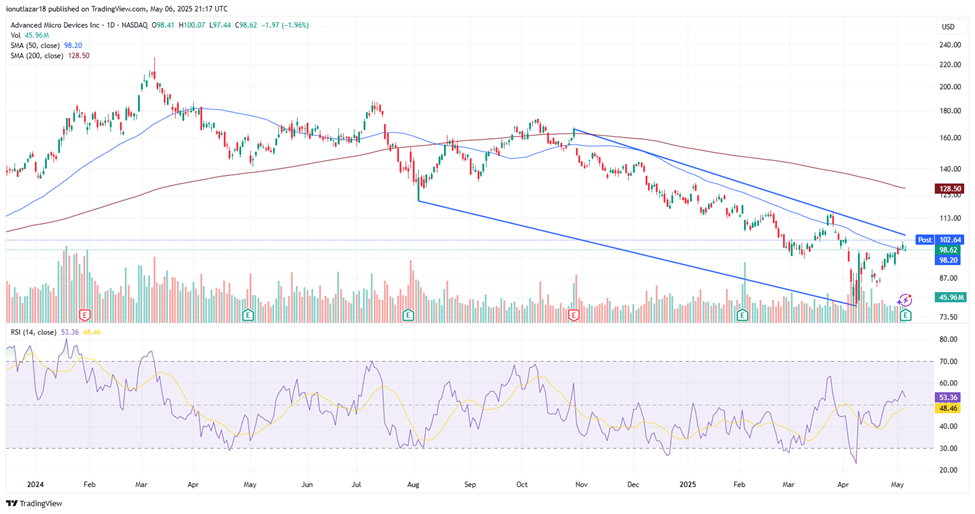
The chart below indicates a clear medium-term downtrend, highlighted by the descending channel formed since mid-2024. The stock has been constantly pressured below the 200-day moving average, which continues to have a negative slope, reinforcing the bearish nature of the dominant trend. However, in the recent period, the stock has managed to recover ground and slightly exceed the 50-day moving average in the recent period, suggesting a possible change in sentiment in the short term. This development may signal the beginning of an attempt to exit the negative trend, but confirmation would require staying above this area in the next sessions. The RSI indicator (53.36) supports this moderate recovery scenario, being in the neutral zone, but slightly upward oriented.
Author: Ionuț-Adrian Lazar