ASML reports resilient Q2 2025 results amid strong AI-driven semiconductor demand
Overview
ASML Holding NV reported strong financial results for the second quarter of 2025, supported by continued growth in artificial intelligence applications and customer demand for advanced lithography solutions. The Dutch semiconductor equipment manufacturer posted total net sales of €7.69bn and a net income of €2.29bn, maintaining its trajectory toward double-digit annual growth.
Q2 2025 vs. Q2 2024
- Total net sales reached €7.69bn (+23% YoY), primarily driven by robust demand for both EUV and DUV systems as well as Installed Base Management (IBM) services.
- Net system sales were €5.6bn, while Installed Base Management revenue, which includes services and field upgrades, rose to €2.1bn, up from €1.48bn in Q2 2024.
- Net bookings came in at €5.54bn, including €2.3bn in EUV bookings, signaling continued interest in next-gen nodes.
- Gross margin improved to 53.7%, up from 51.5% in the same period last year, reflecting an improved product mix and operational efficiencies.
- Operating margin increased to 34.6%, while net income margin climbed to 29.8%, versus 25.3% in Q2 2024.
- Diluted EPS stood at €5.90, up from €4.01 in the prior year.
- ASML shipped the first EXE:5200B system in Q2, a key milestone in advancing High-NA EUV technology. This system improves overlay performance and throughput, supporting future scaling in advanced logic manufacturing.
- The lithography systems sold in Q2 totaled 76 units, slightly lower than Q1 2025 (77 units), reflecting shipment timing and mix.
- The installed base of systems continues to drive a recurring revenue stream through service agreements, upgrades, and field options.
- R&D expenses were €1.17bn (+6% YoY), reflecting sustained investment in EUV, High-NA, and metrology technologies.
- SG&A expenses rose to €299m (+8% YoY), partially due to expanded customer engagement and higher employee-related costs.
- Free cash flow totaled €319m, recovering from negative FCF in Q1. Operating cash flow reached €748m, while capital expenditures remained steady at €429m.
- Cash and short-term investments declined to €7.25bn, down from €12.74bn at the end of 2024, primarily due to €1.4bn in share repurchases and €714m in dividends paid.
- ASML returned approximately €2.1bn to shareholders in Q2 via dividends and buybacks.
- The company declared a €1.60 per share interim dividend for Q2, payable in August, adding to a total of €6.40 per share in dividends related to fiscal 2024 performance.
ASML has reaffirmed its full-year 2025 guidance, anticipating approximately 15% net sales growth compared to fiscal year 2024, with a gross margin around 52% and an annualized effective tax rate of about 17%. The company expects R&D and SG&A expenses to remain consistent with Q2 run-rates. For the third quarter of 2025, ASML forecasts net sales in the range of €7.4bn to €7.9bn, including approximately €2.0bn in revenue from Installed Base Management, and a gross margin between 50% and 52%, reflecting stable operational performance and continued strategic execution. ASML emphasized continued focus on AI-related demand, strong ESG commitments, and its role as a cornerstone in next-generation semiconductor production. The company sees a clear path to achieving €44-€60bn in annual revenues by 2030, depending on market intensity and adoption of its lithography solutions.
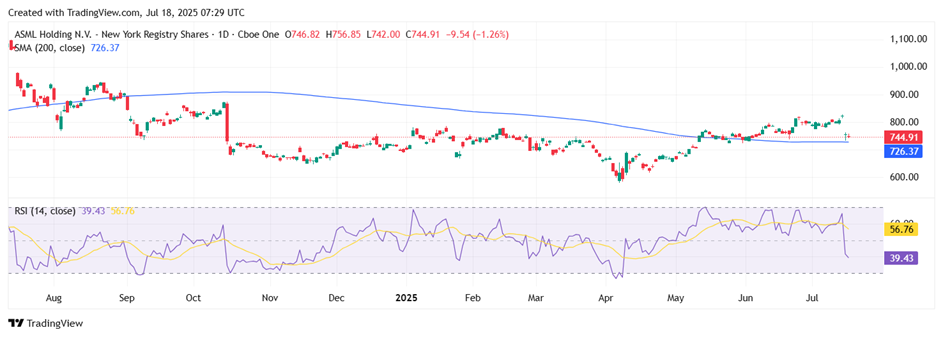
From a technical perspective, ASML experienced a notable decline following its Q2 2025 earnings release, with the stock falling over 5% in the days after the announcement. Despite previously building upward momentum and trading above the 200-day simple moving average (on the U.S. listing), the recent drop suggests that investors may have reacted cautiously to the outlook or results, triggering a short-term correction. The RSI has also fallen sharply to 39.43, entering bearish territory and indicating weakening buying pressure. While the longer-term technical setup remains constructive, supported by a recovery trend since April, the current pullback highlights potential near-term volatility and the importance of support levels around $726. A sustained move below these levels could signal further downside, whereas a stabilization above them may suggest the market is digesting the guidance before reassessing future growth prospects.
Author: Andreea-Roxana Danci
Discover more from FSEGA Investment Club
Subscribe to get the latest posts sent to your email.