Cross-border volume strength and expanding value-added services drive performance for Mastercard in Q2 2025
Overview
Mastercard delivered strong second-quarter 2025 results, reflecting robust global consumer spending, continued recovery in cross-border travel, and significant growth in value-added services. Double-digit increases in revenue and earnings were supported by operating leverage and disciplined investment in technology and innovation.
CEO Michael Miebach highlighted that Mastercard’s diversified business model, global reach, and expanding suite of services continue to position the company for sustainable growth: “Our momentum of deal wins continued this quarter, including the extension of our exclusive partnership with American Airlines. Overall, the second quarter was another strong one for Mastercard, with net revenue growth of 17% year-over-year, or 16% on a currency-neutral basis. These results reinforce how our teams are executing every day and delivering value in every transaction and beyond. We’re well positioned for the opportunities ahead and continue to drive new innovation like the Mastercard Collection and Mastercard Agent Pay.”
Q2 2025 vs. Q2 2024:
- Net revenue was $8.1bn (+17% YoY and +16% on a currency-neutral basis), driven by higher payment volumes and expanding value-added services.
- Payment network net revenue increased 13%, as reported and on a currency-neutral basis. Gross dollar volume was $2.6tn (+9% YoY), with cross-border volume up 15% and switched transactions up 10%. Rebates and incentives rose 17% YoY, reflecting higher volumes and new or renewed customer agreements.
- Value-added services and solutions net revenue increased 23%, or 22% on a currency-neutral basis. This includes a 4 percentage point increase from acquisitions. The remaining increase was driven primarily by the security and digital and authentication solutions, and consumer acquisition and engagement services, growth in our underlying key drivers, and pricing.
- GAAP net income was $3.7bn (+14% YoY), reflecting strong top-line growth and favorable operating leverage.
- Diluted EPS was $4.07 (+16% YoY), supported by earnings growth and share repurchases.
- Adjusted net income was $3.8bn, with adjusted EPS of $4.15, both increasing 13% and 16% YoY, respectively.
- Operating income reached $4.8bn (+18% YoY), with an operating margin of 58.7%, improving 0.8 percentage points versus last year.
- Operating expenses rose to $3.4bn (+15% YoY), reflecting higher personnel costs, technology investments, and acquisition-related expenses.
Mastercard expects to maintain sustainable double-digit revenue growth for the full year 2025, supported by ongoing cross-border momentum, increasing e-commerce activity, and the rapid expansion of its value-added services portfolio. Operating expenses are projected to grow in the low- to mid-teens range, as the company continues to invest in technology, cybersecurity, and new partnerships to strengthen its ecosystem and drive long-term growth. Management remains committed to delivering robust capital returns, with $2.3bn returned to shareholders in Q2 2025 through share repurchases and dividends, and $9.3bn remaining authorized for future buybacks. A strong balance sheet and global presence position Mastercard to capitalize on secular trends in digital payments and financial technology innovation.
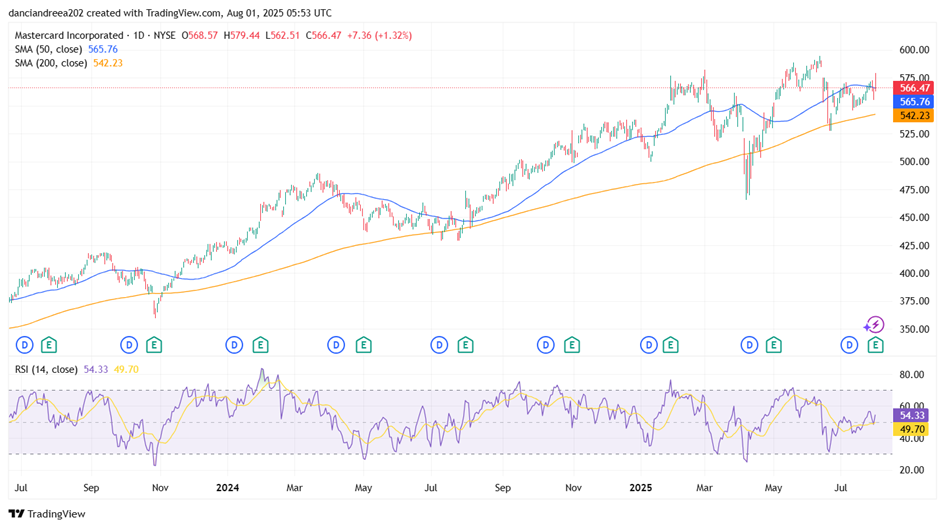
Mastercard is trading up 1.32%, showing moderate bullish momentum. The stock is slightly above its 50-day SMA and well above the 200-day SMA, suggesting a generally positive medium-term trend. The RSI (14) is at 54.33, indicating neutral momentum, with room to move higher without entering overbought territory. This suggests consolidation with potential for further upside if the stock holds above key support levels. Immediate support levels are around $565 and $542, while resistance sits near $580, where recent peaks occurred. A breakout above $580 could signal renewed bullish momentum, whereas a breakdown below $560 may trigger short-term weakness.
Author: Ionuț-Adrian Lazar