Disney grows across segments, prepares for cruise and DTC expansion

Overview
The Walt Disney Company reported a strong second fiscal quarter of 2025, showcasing significant year-over-year earnings growth driven by its Entertainment and Experiences segments.
CEO Bob Iger noted: “Our outstanding performance this quarter—with adjusted EPS up 20% from the prior year driven by our Entertainment and Experiences businesses—underscores our continued success building for growth and executing across our strategic priorities. Following an excellent first half of the fiscal year, we have a lot more to look forward to, including our upcoming theatrical slate, the launch of ESPN’s new DTC offering, and an unprecedented number of expansion projects underway in our Experiences segment. Overall, we remain optimistic about the direction of the company and our outlook for the remainder of the fiscal year.”
Q2 FY2025 vs. Q2 FY2024:
- Revenues increased to $23.6bn (+7% YoY), with growth across all segments, led by Direct-to-Consumer and Content Licensing.
- Entertainment revenue was $10.7bn (+9% YoY).
- Sports revenue was $4.53bn (+5% YoY).
- Experiences revenue was $8.89bn (+6% YoY).
- Total segment operating income grew to $4.44bn (+15% YoY), driven by strength in Entertainment and Experiences.
- Entertainment operating income was $1.26bn (+61% YoY), boosted by Disney+ and Hulu subscriber growth (+2.5m combined) and a rebound in content licensing, while Direct-to-Consumer swung to a $336m profit (+$47m vs. last year).
- Sports operating income declined to $687m (-12% YoY), driven by higher costs from airing more College Football Playoff and NFL games, offset by 29% ad revenue growth at ESPN.
- Experiences operating income grew to $2.49bn (+9% YoY), with U.S. parks and cruise line demand which drove growth (+13% domestic parks income and +14% consumer products).
- Net income experienced an impressive growth to $3.28bn (compared to a loss of -$20m in Q2 FY2024).
- In the same way, diluted EPS recorded a value of $1.81 (vs. -$0.01 in Q2 FY2024), while adjusted EPS was $1.45 (+20% YoY).
- Operating cash flow rose to $6.75bn (+84% YoY), while free cash flow more than doubled, to $4.89bn (+103% YoY), supporting ongoing investments in parks, streaming, and content.
- Disney+ had 126.0m subscribers (+1.4m QoQ), while Average Monthly Revenue Per Paid Subscriber (ARPU) increased to $7.77 (+3% QoQ).
- Hulu had 54.7m subscribers (+2% QoQ), with SVOD-only ARPU of $12.36 (-1% QoQ) and Live TV + SVOD ARPU of $99.94 (+1% QoQ).
- ESPN+ had 24.1m subscribers (-3% QoQ), but with ARPU of $6.58 (+3% QoQ).
- Disney repurchased $1bn in stock during Q2 FY2025, maintaining its target to reach $3bn in buybacks for FY2025.
Disney reaffirmed its full-year outlook, guiding for adjusted EPS of $5.75 (+16% YoY) and $17bn in operating cash flow, up $2bn from previous estimates due to deferred tax payments. The company expects double-digit operating income growth in Entertainment, 18% growth in Sports, and 6-8% growth in Experiences, while planning ~$200m in pre-opening costs for new Disney Cruise Line projects. Management noted ongoing macro uncertainty but remains confident in its forward momentum.
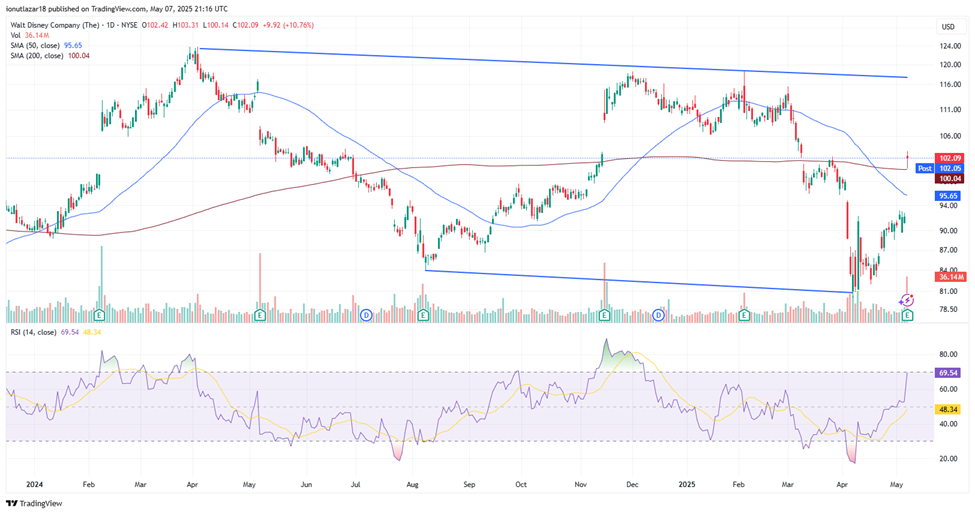
After the publication of the quarterly report, as well as after the confident statements of the company’s management regarding the opening of a new park in the Middle East, DIS shares had an excellent closing price on May 7, increasing by +10.76%. The reporting of financial results triggered a clearly bullish technical reaction for Disney shares. The simultaneous exceeding of the 50- and 200-day moving averages, along with the exit from the descending channel, suggests a possible trend change in favor of buyers. However, the RSI indicator signals a possible short-term overbought condition, which requires caution in waiting for confirmation by maintaining above the $100 threshold in the next trading sessions. Since the beginning of this year, the stock price of the shares is still in a significant decline, by approximately -8.3%, which confirms a possible overreaction of investors immediately after the good news brought by the company to the market.
Author: Ionuț-Adrian Lazar