Eli Lilly delivers 45% revenue growth in Q1 2025, but lowers its guidance
Overview
Eli Lilly delivered an exceptionally strong start to 2025, driven by continued momentum in its diabetes and obesity treatments and substantial pipeline progress.
CEO David Ricks stated: “Lilly had a solid start to the year, with 45% year-over-year revenue growth driven by strong sales of Mounjaro and Zepbound. Our pipeline continued to deliver across key therapeutic areas, with product approvals in oncology and immunology, and the exciting success of our oral incretin, orforglipron, in the first of seven late-stage studies in diabetes and obesity. To support global demand for our newest medicines, we’re accelerating our manufacturing investments, as underscored by our recent announcement to build four new facilities.”
Q1 2025 vs. Q1 2024:
- Revenues were on a strong upward slope, reaching $12.73bn (+45% YoY), driven by a 53% increase in volume, led by Mounjaro and Zepbound, partially offset by lower prices (-6% YoY) and FX (-2% YoY).
- Mounjaro revenue was $3.84bn (+113% YoY), with U.S. growth of +75% and international revenue nearly quadrupled as the product entered new markets.
- Zepbound revenue was $2.31bn (vs. $517m in Q1 2024), driven by accelerating U.S. demand for obesity treatment.
- Verzenio revenue was $1.16bn (+10% YoY), with international growth of +22% YoY outpaced modest U.S. gains (+3% YoY), amid wholesaler and competitive headwinds.
- Key products total revenues were $7.52bn (+$4.09bn YoY), which includes Mounjaro, Zepbound, Verzenio, Omvoh, Ebglyss, Jaypirca, and Kisunla.
- Gross margin increased to $10.50bn (+48% YoY), primarily driven by improved cost of production and favorable product mix, partially offset by lower realized prices.
- R&D expenses were $2.73bn (+8% YoY), driven by continued investments in the company’s early and late-stage portfolio.
- S&A expenses also increased to $2.47bn (+26% YoY), primarily driven by promotional efforts supporting ongoing and future launches.
- Reported net income grew to $2.76bn (+23% YoY), while non-GAAP net income was $3.00bn (+29% YoY), which excludes $1.57bn in acquired IPR&D charges, primarily related to the Scorpion Therapeutics acquisition, factored into updated EPS guidance.
- In the same way, diluted EPS rose to $3.06 (+23% YoY), while non-GAAP EPS recorded a value of $3.34 (+29% YoY).
- The effective tax rate was 20.2% (compared with 11.6% in Q1 2024), primarily driven by the unfavorable tax impact of a non-deductible acquired IPR&D charge in Q1 2025.
- Dividends paid by the company were $1.50/share (+15% YoY).
- The company also plans to more than double U.S. manufacturing investment (>$50bn).
Lilly reaffirmed its 2025 revenue guidance of $58.0bn-$61.0bn. EPS guidance was lowered to $20.17-$21.67 reported and $20.78-$22.28 non-GAAP, primarily reflecting $1.72 per share in Q1 IPR&D charges and losses on equity investments. The company continues to target a performance margin of 41.5%-43.5% (non-GAAP) and raised its expected tax rate from 16% to 17%. Capital expenditures will support expanded capacity for high-demand therapies such as Mounjaro and Zepbound.
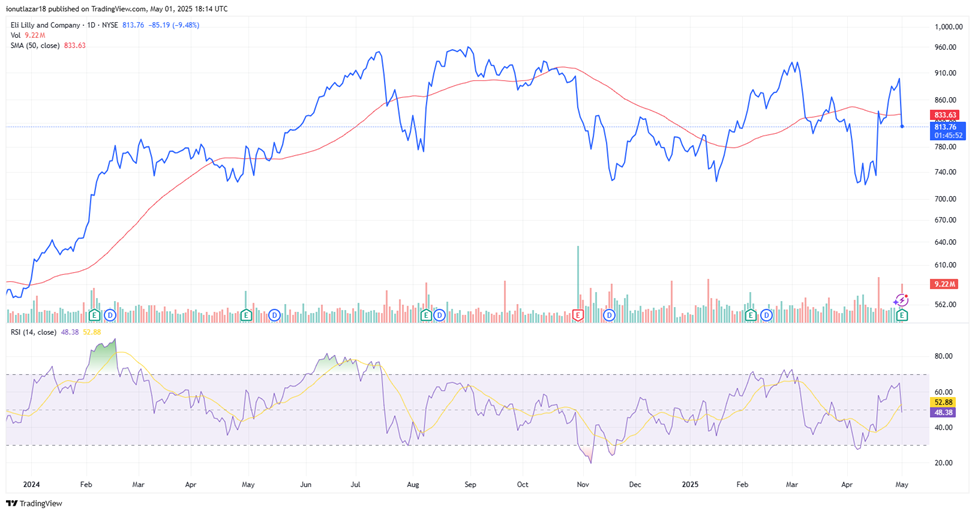
Despite the very good financial performance, which beat the main estimates of Wall Street analysts, the stock price of LLY shares has experienced a decline after the publication of the quarterly report by approximately -9.5% until the time of writing this news, mainly due to the decrease in expectations regarding EPS. Thus, after a brief period of a few days in which the company’s share price broke through and rose above the 50-day moving average, it has again passed below this average, which is likely to bring negative sentiment among investors again this weekend. However, since the beginning of this year, the LLY share price is currently increasing, by approximately +4.5%.
Author: Ionuț-Adrian Lazar
Discover more from FSEGA Investment Club
Subscribe to get the latest posts sent to your email.