Ford delivers record sales and optimizes EV strategy in 2024

Overview
Ford Motor Company reported a strong financial performance for Q4 and record-high revenue for the full year 2024. Revenue reached $48.2bn in Q4, while full-year revenue hit $185bn, marking the highest in the company’s history. Net income for 2024 totaled $5.9bn, with an adjusted EBIT of $10.2bn.
CEO Jim Farley emphasized Ford’s transformation under the Ford+ strategy, stating: “Ford is becoming a fundamentally stronger company. We finished 2024 with a solid fourth quarter, capping the highest revenue year in Ford’s history. In 2025, we expect to make significantly more progress on our two biggest areas of opportunity – quality and cost – as we enter the heart of our Ford+ transformation. We control those key profit drivers, and I am confident that we are on the right path to create long-term value for all our stakeholders.”
Q4 2024 vs. Q4 2023:
- Revenue increased to $48.2bn (+5% YoY), driven by strong demand for Ford Pro and Ford Blue vehicles.
- Net income reached $1.8bn, a sharp contrast to the $0.5bn loss in Q4 2023.
- Adjusted EBIT saw a significant jump to $2.1bn (+91% YoY), reflecting improved vehicle margins and cost efficiencies.
- Diluted EPS stood at $0.45 per share, a notable improvement compared to the -$0.13 per share in Q4 2023.
- The company generated $3.0bn (+20% YoY) in operating cash flow and $0.7bn (-65% YoY) in adjusted free cash flow.
- Looking at individual business segments, Ford Blue, which includes traditional internal combustion engine (ICE) and hybrid vehicles, reported an EBIT of $1.58bn (+94% YoY), supported by higher-margin truck and SUV sales.
- Ford Pro, the company’s commercial vehicle division, posted an EBIT of $1.63bn (-10% YoY), primarily due to increased investments in fleet electrification.
- Ford Model e, the electric vehicle (EV) division, reported an EBIT loss of $1.39bn, as the company continued to invest in EV technology while facing lower wholesale volumes.
Full-Year 2024 highlights:
- With record-high revenue of $185bn (+5% YoY) and net income of $5.9bn (+37% YoY), the company demonstrated improved profitability and cost management.
- Adjusted EBIT slightly declined to $10.2bn (-2% vs. 2023), primarily due to challenges in the EV market.
- Ford generated $15.4bn (+3% YoY) in operating cash flow and $6.7bn (-1.5% YoY) in free cash flow, ensuring strong liquidity.
- Breaking down segment performance, Ford Blue generated $101.9bn in revenue (flat YoY), maintaining a stable performance despite lower wholesale volumes, thanks to strong pricing power.
- Ford Model e revenue dropping to $3.9bn (-35% YoY), as EV demand weakened and Ford adjusted production accordingly.
- On the other hand, Ford Pro achieved $66.9bn in revenue (+15% YoY), driven by strong demand for commercial vehicles and services.
For 2025 outlook, Ford anticipates a transition year, balancing growth in ICE and hybrid models while taking a more measured approach to EV expansion. The company expects adjusted EBIT between $7.0bn and $8.5bn, reflecting EV headwinds and ongoing cost efficiency measures. Adjusted free cash flow is projected at $3.5bn to $4.5bn, ensuring strong liquidity. Capital expenditures are expected to range from $8.0bn to $9.0bn, with investments focused on EV battery plants, AI-driven vehicle software, and hybrid innovation.
Among its business segments, Ford Blue is forecasted to generate $3.5bn to $4.0bn in EBIT, supported by high-margin vehicle sales, while Ford Pro is expected to maintain strong profitability, with EBIT between $7.5bn and $8.0bn, benefiting from steady demand and software-driven revenue streams. However, Ford Model e is projected to post losses between $5.0bn and $5.5bn, as Ford adjusts its EV strategy to align with market trends. Meanwhile, Ford Credit is expected to contribute approximately $2.0bn in earnings, reinforcing strong financing operations and supporting the company’s strategic growth plans.
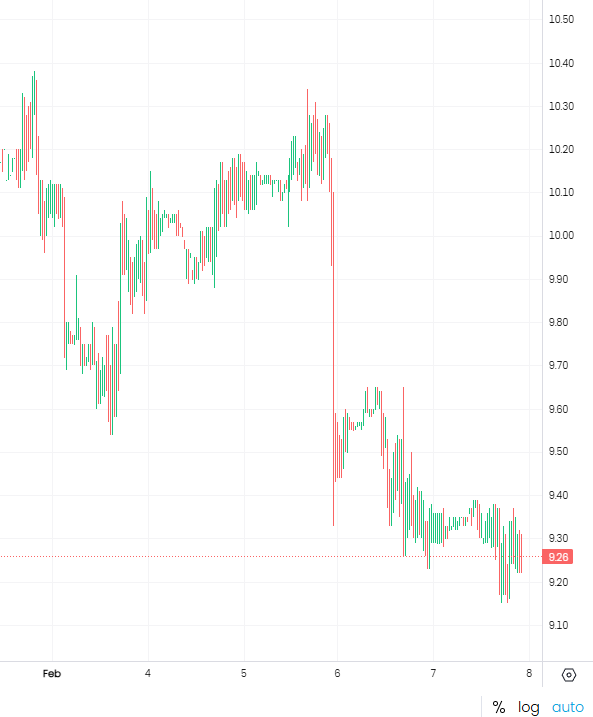
Although the main reported results met or even exceeded Wall Street analysts’ expectations, the forecasts for Q1 2025 brought negative sentiment among investors, with the price of F shares decreasing by over 9% after the results were published.
Author: Andreea-Roxana Danci