Goldman Sachs delivers one of its best quarters ever

Overview
Goldman Sachs delivered a strong performance in the first quarter of 2025, reporting its third-highest quarterly net revenue in history and robust profitability. The quarter was marked by record results in Equities and Financing, improved credit performance, and effective capital management.
Chairman and CEO David Solomon commented: “Our strong results this quarter have demonstrated that in times of great uncertainty, clients turn to Goldman Sachs for execution and insight. While we are entering the second quarter with a markedly different operating environment than earlier this year, we remain confident in our ability to continue to support our clients.”
Q1 2025 vs. Q1 2024:
- Net earnings recorded a value of $4.74bn (+15% YoY), with diluted EPS of $14.12 (compared to $11.58 in Q1 2024 and $11.95 in Q4 2024).
- Net revenues were $15.06bn (+6% YoY and +9% QoQ), driven by higher net revenues in Global Banking & Markets, partially offset by slightly lower net revenues in Asset & Wealth Management.
- Global Banking & Markets revenue recorded a value of $10.71bn (+10% YoY), driven by record net revenues in Equities (including record net revenues in financing) and strong performances in Fixed Income, Currency and Commodities (including record net revenues in financing) and Debt underwriting.
- Net revenues in Fixed Income, Currency and Commodities (FICC) were $4.40bn (+2% YoY), reflecting higher net revenues in FICC financing, driven by significantly higher net revenues from mortgages and structured lending.
- Net revenues in Equities were $4.19bn (+27% YoY), due to significantly higher net revenues in Equities intermediation (primarily reflecting significantly higher net revenues in derivatives) and in Equities financing (primarily reflecting significantly higher net revenues in portfolio financing).
- Investment Banking fees were $1.91bn (-8% YoY), as lower advisory revenues offset debt underwriting strength.
- Asset & Wealth Management revenue was $3.68bn (-3% YoY), down due to lower equity and debt investment results.
- Management and other fees increased to $2.70bn, reflecting AUM growth.
- Assets under supervision (AUS) reached a record $3.17tn, with $24bn in net inflows.
- Platform Solutions revenue was $676m (-3% YoY and flat QoQ).
- Transaction banking and other net revenues were $65m, lower compared with the Q1 2024, primarily reflecting lower average deposit balances.
- Consumer platforms net revenues were $611m, essentially unchanged compared with the Q1 2024.
- Global Banking & Markets revenue recorded a value of $10.71bn (+10% YoY), driven by record net revenues in Equities (including record net revenues in financing) and strong performances in Fixed Income, Currency and Commodities (including record net revenues in financing) and Debt underwriting.
- Net interest income grew to $2.90bn (+111% YoY), benefiting from improved balance sheet efficiency.
- Operating expenses increased slightly to $9.13bn (+5% YoY), driven by higher compensation and transaction-based costs.
- Provision for credit losses were $287m (-10% YoY), primarily reflecting credit card portfolio dynamics.
- Effective tax rate was 16.1%, down from 22.4% in FY2024, driven by share-based award settlements.
- Return on Equity (ROE) recorded a value of 16.9%, while Return on Tangible Common Equity (ROTCE) was 18.0%.
- Book value per share increased to $344.20 (+2.2% YoY).
- The firm ranked #1 in worldwide announced and completed mergers and acquisitions, equity and equity-related offerings and common stock offerings, and ranked #2 in high-yield debt offerings and leveraged loan offerings, for the year-to-date.
- Goldman Sachs returned $5.34bn to shareholders, including $4.36bn in share repurchases (7.1m shares at ~$611 average price) and $976m in dividends. A new $40bn share repurchase authorization was approved by the Board during the quarter.
- CET1 ratio stood at 14.8% (standardized) and 15.5% (advanced), indicating a strong capital base.
Goldman Sachs enters Q2 2025 facing a shifting macro landscape, yet remains optimistic about client activity and its competitive position. With strong performance in global markets, expanding assets under supervision, and a healthy capital position, the firm is well-positioned to navigate continued uncertainty and capitalize on opportunities in M&A, capital markets, and institutional investing.
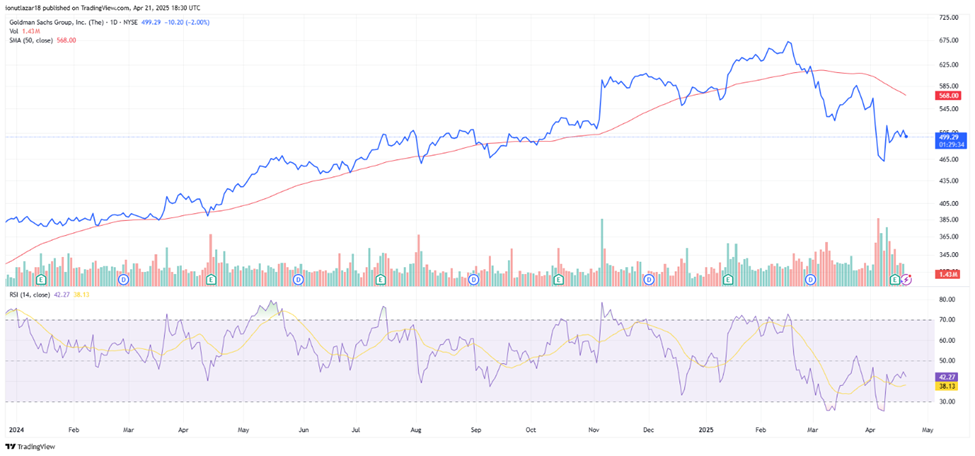
Even though the main results reported for the first quarter of 2025 were among the best in the company’s history, GS’s share price has fallen by about -2% since the announcement, experiencing quite high volatility, which has already become a habit for this period. Moreover, since the beginning of this year, the stock price has fallen by more than -13%, and since the beginning of March, it has been below the 50-day moving average, another clear signal that investors do not have very optimistic feelings about the future of the American market in general.
Author: Ionuț-Adrian Lazar