iPhone 16e and Services drive Apple’s strong Q2 FY2025

Overview
Apple delivered a strong second quarter for fiscal 2025, led by record Services revenue and growth across key hardware segments. Despite FX headwinds and cautious consumer spending in some markets, Apple reported higher earnings and revenue year-over-year.
CEO Tim Cook noted: “Today Apple is reporting strong quarterly results, including double-digit growth in Services. We were happy to welcome iPhone 16e to our lineup, and to introduce powerful new Macs and iPads that take advantage of the extraordinary capabilities of Apple silicon. And we were proud to announce that we’ve cut our carbon emissions by 60 percent over the past decade.”
Q2 FY2025 vs. Q2 FY2024:
- Total net sales increased to $95.4bn (+5% YoY), driven by Services (all-time high) and solid growth in iPhone, Mac, and iPad categories.
- iPhone sales grew to $46.84bn (+2% YoY), boosted by iPhone 16e launch.
- Mac sales were $7.95bn (+7% YoY), a recovery driven by new M-series chips.
- iPad sales also increased to $6.40bn (+15% YoY), a strong upgrade cycle and education demand.
- Wearables, Home & Accessories sales declined to $7.52bn (-5% YoY), a softness attributed to seasonality and market saturation.
- Services sales reached $26.65bn (+12% YoY, all-time high), led by App Store, iCloud, and Apple Music.
- Americas sales recorded a value of $40.3bn (+8% YoY), the strongest region, driven by iPhone and Services.
- Europe sales increased slightly to $24.5bn (+1% YoY), a flat growth amid FX pressures.
- Greater China sales decreased to $16.0bn (-2% YoY), a modest decline amid local competition.
- Japan sales rose to $7.3bn (+17% YoY), reflecting a strong demand for iPhone and iPad.
- Rest of Asia Pacific sales were $7.3bn (+8% YoY), a healthy rebound across product lines.
- Net income grew to $24.78bn (+5% YoY), supported by improved product mix and cost discipline.
- Diluted EPS was $1.65 (+8% YoY, a new March quarter record), with EPS growth which outpaced revenue due to share repurchases and margin improvement.
- Operating income also increased to $29.59bn (+6% YoY), reflecting a strong profitability across product and services businesses.
- Total operating expenses were also on an upward slope, reaching $15.28bn (+6% YoY).
- Gross margin was $44.87bn (+6% YoY) or 47% of revenue, reflecting high-margin contribution from Services and Apple Silicon-based hardware.
- In Q2 FY2025, Apple returned a total of $29bn to shareholders, including $22.5bn in share repurchases and $6.5bn in dividends.
- The company also announced a 4% dividend increase to $0.26/share and a new $100bn stock repurchase authorization.
- Operating cash flow reached $24bn, demonstrating Apple’s continued strong cash generation and capital return commitment.
Apple did not issue formal revenue or EPS guidance but reaffirmed its strategic focus on innovation, platform integration, and environmental leadership. Management emphasized the growing installed base of active devices, momentum in Services, and continued investment in Apple Silicon and AI technologies. Risks remain related to FX, global supply chains, and macroeconomic conditions, particularly in China.
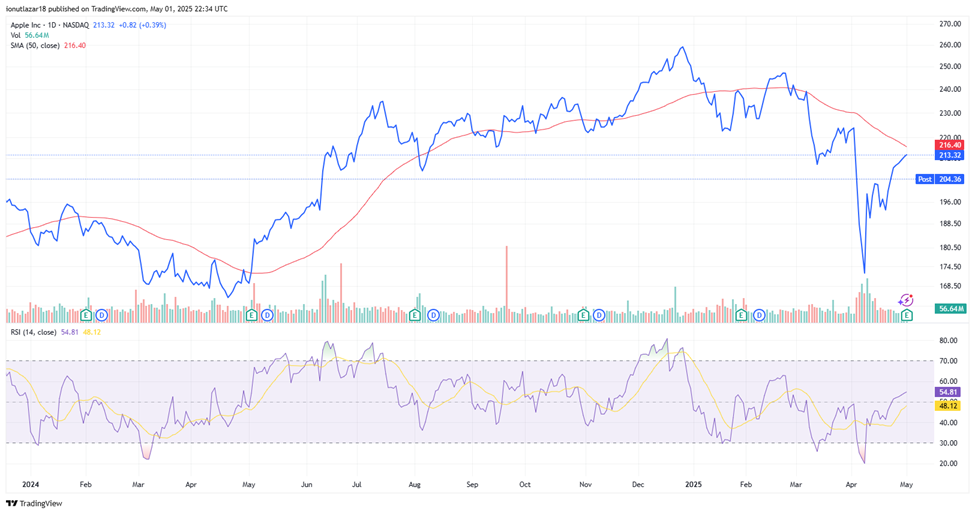
Even though the financial results for this quarter beat the main analysts’ estimates, global economic uncertainties, as well as the fact that Apple proved to be one of the companies most affected by the imposition of trade tariffs by President Donald Trump, caused the price of AAPL shares to fall immediately after the publication of the quarterly report by approximately -4% by the time of writing this article, mainly due to the decrease in sales in China. Also, a statement by the company’s management regarding the impact of customs duties on the company’s activity brought negative feelings among investors, who did not think in the after-market trading session and reacted quite strongly. In addition, since the beginning of 2025, the stock price of AAPL shares has collapsed by approximately -12.5%, failing to significantly exceed the 50-day moving average in the first four months of the year.
Author: Ionuț-Adrian Lazar
Discover more from FSEGA Investment Club
Subscribe to get the latest posts sent to your email.