Robust cloud momentum and margin expansion in Q2 for SAP strengthen full-year outlook

Overview
SAP SE, Europe’s largest software company, delivered a solid second quarter of 2025, driven by accelerated adoption of cloud solutions, resilient customer demand, and strong operating leverage. As organizations continue investing in digital transformation, SAP’s cloud portfolio and AI-powered innovations remain central to its strategic growth.
Christian Klein, CEO: “We have delivered yet another quarter of outstanding results. AI innovations such as Joule becoming available “everywhere and for everything” and SAP Business Data Cloud as a powerful accelerator of AI make our portfolio ever stronger. Enterprise operations are about to enter a new era, and SAP is best positioned to benefit from that evolution.”
Dominik Asam, CFO: “We achieved a very good Q2, with accelerating total revenue growth, strong profitability and free cash flow. Our performance was supported by continued customer demand and disciplined cost control. As we move into the second half, we remain cautiously optimistic, keeping a close eye on geopolitical developments and public sector trends.”
Q2 2025 vs. Q2 2024:
- Total revenue reached €9.03bn (+9% YoY or +12% at constant currencies), driven by strong demand for cloud-based solutions and successful customer migrations to SAP S/4HANA Cloud.
- Cloud revenue rose to €5.13bn (+24% YoY or +28% at constant currencies), highlighting SAP’s accelerating shift to a recurring revenue model.
- Cloud and software revenue increased to €7.97bn (+11% YoY), underpinned by robust uptake of the Cloud ERP Suite, which saw a growth to €4.42bn (+30% YoY).
- Operating profit (IFRS) climbed to €2.46 billion, reflecting a surge of over 100% YoY, largely due to efficiency gains from the 2024 transformation program and lower restructuring costs.
- Non-IFRS operating profit grew also to €2.57bn (+32% YoY or +35% at constant currencies), as SAP continued to execute on margin expansion.
- Operating margin (IFRS) rose by 12.5 percentage points to 27.2%, while non-IFRS operating margin improved by 5.0 percentage points to 28.5%.
- EPS (IFRS) increased to €1.45 (+91% YoY), while non-IFRS EPS rose to €1.50 (+37% YoY). This was primarily driven by higher operating income and reduced share-based compensation expenses.
- Free cash flow amounted to €2.36bn (+83% YoY), supported by improved working capital, lower restructuring and tax-related payments.
- Operating cash flow also surged to €2.58bn (+71% YoY).
- The current cloud backlog rose to €18.05bn (+22% YoY and +28% at constant currencies), highlighting strong forward visibility and sustained demand for cloud-based solutions.
- The share of more predictable revenue increased to 86%, up 2 percentage points YoY, reflecting the company’s focus on subscription-based offerings.
- SAP extended the contracts of CEO Christian Klein and CFO Dominik Asam, reinforcing leadership continuity. The company also strengthened partnerships with Accenture, Alibaba, and Palantir, underlining its ambition to become a key enabler of intelligent enterprise transformation.
- Shareholders approved a dividend of €2.35 per share for FY 2024 at the AGM held in May 2025.
Despite ongoing macroeconomic uncertainty, SAP reaffirmed its positive outlook for 2025. The company expects cloud revenue between €21.6bn and €21.9bn, up 26-28% YoY, and cloud & software revenue between €33.1bn and €33.6bn, representing 11-13% growth. Non-IFRS operating profit is projected at €10.3bn-10.6bn (+26-30%), while free cash flow is expected to reach around €8.0bn, nearly doubling last year’s level. The non-IFRS effective tax rate is forecasted at approximately 32%. Currency headwinds could impact reported results, with estimated reductions of 3.5pp for cloud revenue, 3.0pp for cloud & software, and 3.0pp for operating profit growth. On the non-financial side, SAP targets a Business Health Culture Index of 80-82%, a Customer Net Promoter Score of 12 to 16, and an Employee Engagement Index of 74-78%, while continuing its efforts to reduce carbon emissions across the value chain.
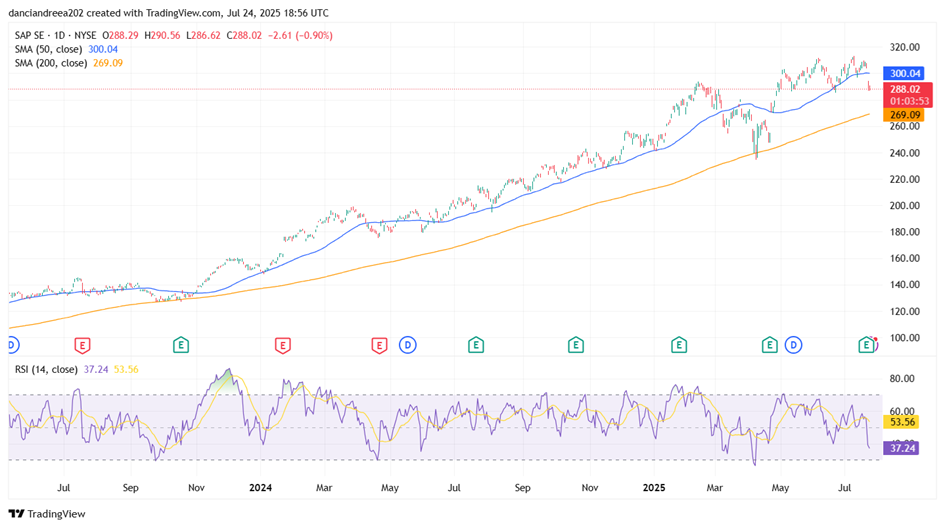
Despite reporting strong Q2 2025 results and raising its full-year guidance, SAP’s stock closed lower on the day of the earnings release. This suggests that much of the positive momentum had already been priced in or that short-term profit-taking occurred after a prolonged uptrend. Technically, SAP remains in a long-term bullish trend, consistently trading above its 200-day simple moving average. However, recent weakness has brought the price below the 50-day SMA, signaling short-term pressure and the potential for a deeper pullback if support levels are breached. The RSI has dropped to 37.24, approaching oversold territory, which could suggest a near-term rebound if buying interest returns. Still, the downward momentum indicates cautious investor sentiment in the short term. As long as the price holds above the $280-285 range (next support zone), the longer-term uptrend remains intact. A recovery above $300 would be needed to reestablish short-term bullish momentum.
Author: Ionuț-Adrian Lazar