
Target delivers Q2 2025 results with improved trends but lower profitability, while board appoints new CEO

Overview
Target Corporation reported second quarter 2025 earnings marked by improved traffic and sales momentum compared to the first quarter, with strength in digital channels and non-merchandise sales. However, operating income and net earnings declined year-over-year due to margin pressures and softer in-store sales. The company also announced that Michael Fiddelke has been appointed as Target’s next Chief Executive Officer, signaling leadership continuity and strategic focus as the retailer heads into the key back-to-school and holiday seasons.
Brian Cornell, chair and chief executive officer of Target Corporation said: “With the board’s unanimous decision to appoint Michael Fiddelke as Target’s next CEO, I want to express my full confidence in his leadership and focus on driving improved results and sustainable growth. He’s contributed meaningfully during times of change and played a critical role in establishing the differentiated capabilities that will continue to drive Target forward. Michael brings a deep understanding of our business and a genuine commitment to accelerating our progress. Today, we also reported our second quarter earnings, which showed encouraging signs of recovery, including improved traffic and sales trends — particularly in our stores — and disciplined cost management in a challenging retail environment. As we enter the critical back-to-school and holiday seasons, our team remains focused on consistent execution and building momentum as we look ahead to the new year.”
Q2 2025 vs. Q2 2024:
- Net sales were $25.2bn (-0.9% YoY), reflecting a 1.2% decline in merchandise sales partly offset by a 14.2% increase in non-merchandise sales such as advertising, membership, and marketplace services.
- Comparable sales fell 1.9%, as comparable store sales dropped 3.2%, while digital comparable sales grew 4.3% on strong demand for Target Circle 360, same-day delivery, and Drive Up.
- GAAP and adjusted EPS came in at $2.05, down from $2.57 a year earlier, with strong expense management partially offsetting tariff-related and merchandising cost pressures.
- Operating income was $1.3bn (-19.4% YoY), with the operating margin rate decreasing to 5.2% from 6.4%.
- Gross margin rate contracted to 29.0% from 30.0%, pressured by higher markdowns, purchase order cancellation costs, and category mix, partially offset by lower inventory shrink and growth in non-merchandise revenue.
- SG&A expenses were nearly flat at $5.36bn (-0.1% YoY), though the SG&A rate increased slightly to 21.3% from 21.1% due to deleveraging on lower sales.
- Net earnings fell $935m (-21.5% YoY), reflecting lower operating income and higher interest expense ($116m vs. $110m a year ago).
- Return on invested capital (ROIC) for the trailing twelve months was 14.3% (compared to 16.6% a year ago), reflecting weaker profitability metrics.
For fiscal 2025, Target reaffirmed guidance of a low-single-digit sales decline, GAAP EPS of $8.00 to $10.00, and adjusted EPS of approximately $7.00 to $9.00 (excluding litigation settlement gains recorded in Q1). Management emphasized improving sales momentum, disciplined cost control, and consistent execution as the company enters the critical back-to-school and holiday seasons, positioning for stabilization and gradual recovery into 2026.
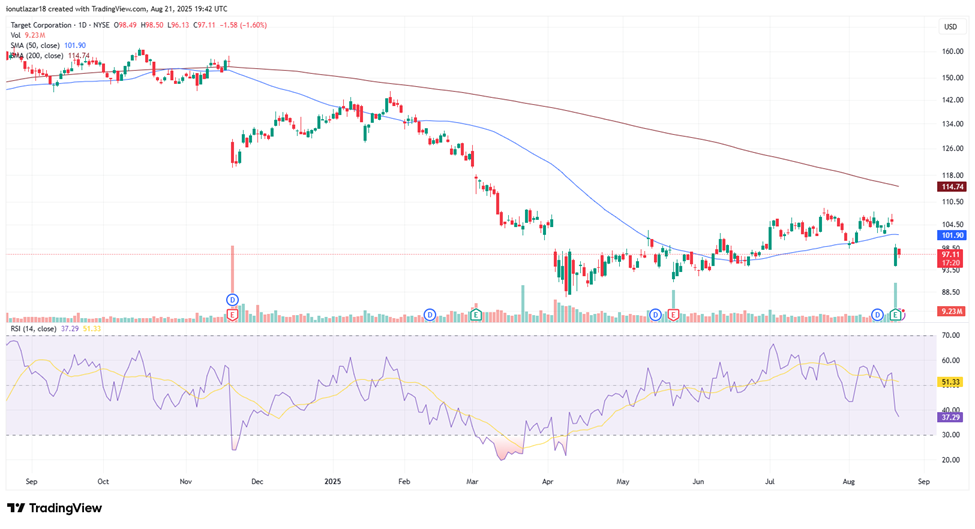
Following the latest earnings release, Target shares opened sharply lower, dropping -6.3% and breaking below the 50-day SMA ($101.90). The negative momentum continued, with an additional decline of about -1.6% at the time of writing, reinforcing the ongoing downward trend. Technically, the stock remains under pressure, with both the 50-day and 200-day SMAs ($114.74) pointing to persistent weakness. The RSI currently sits at 37.29, still in a neutral-to-oversold zone, leaving room for further downside should selling pressure continue. Year-to-date, the stock has lost nearly -30%, and given the lack of strong reversal signals, the bearish bias remains dominant in the near term.
Author: Ionuț-Adrian Lazar