
TSMC stays resilient in Q1 2025 amid trade policy uncertainty

Overview
Taiwan Semiconductor Manufacturing Company Limited (TSMC) delivered a strong year-over-year performance in Q1 2025, reporting substantial growth in both revenue and profit, driven by continued demand for advanced nodes, particularly in AI-related applications.
However, quarter-over-quarter results showed a slight decline due to typical smartphone seasonality.
“Our business in the first quarter was impacted by smartphone seasonality, partially offset by continued growth in AI-related demand”, said CFO Wendell Huang. He added that demand for 3nm and 5nm technologies is expected to drive performance in Q2, though global economic risks and potential tariff impacts remain uncertainties.
Q1 2025 vs. Q1 2024
- Revenue recorded a value of NT$839.25bn (+41.6% YoY, but -3.4% QoQ) or US$25.53bn (+35.3% YoY, but -5.1% QoQ), due to seasonal smartphone demand.
- Net income was on a steep upward slope, increasing to a value of NT$361.56bn (+60.3% YoY).
- In the same way, EPS grew to NT$13.94 or US$2.12 per ADR (+60.4% YoY).
- Gross margin for the quarter was 58.8%, operating margin was 48.5%, and net profit margin was 43.1%.
- Advanced nodes (7nm and below) contributed 73% of wafer revenue: 3nm accounted for 22%, 5nm contributed 36% and 7nm made up 15%. The growth was fueled by AI-related demand, offsetting a seasonal dip in smartphone chip orders.
Looking ahead to the second quarter of 2025, TSMC expects to maintain strong momentum, driven by continued demand in high-performance computing and AI applications. The company forecasts revenue in the range of US$28.4bn to US$29.2bn, with a projected gross margin between 57% and 59%, and an operating margin between 47% and 49%. While TSMC remains cautious amid ongoing uncertainties surrounding global trade policies, it remains confident in its strategic positioning and long-term growth potential, supported by its leadership in advanced semiconductor technologies.
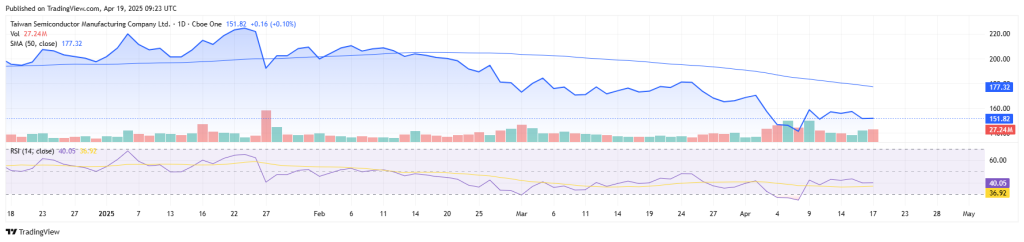
After President Donald Trump’s return to the White House, which, together with the implementation of trade tariffs, created increased volatility on international markets, TSMC shares are still trading below the 50-day moving average, and the announcement of the publication of results for the first quarter of 2025 did not bring significant movements, the stock price remaining relatively stable on the last trading day of this week. Since the beginning of this year, TSMC’s stock price has fallen by approximately -25%, being undoubtedly one of the companies most affected by the imposition of trade tariffs, even if the company’s results do not seem to have suffered for the time being.
Author: Ionuț-Adrian Lazar