UnitedHealth Group presented rebuilding performance amid elevated medical cost trends in Q2 2025

Overview
UnitedHealth Group reported Q2 2025 results reflecting strong top-line growth but significant margin pressure from higher-than-anticipated medical costs. The company re-established its full-year 2025 outlook, incorporating revised expectations for medical cost trends and Medicare funding impacts.
CEO Stephen Hemsley emphasized the company’s focus on restoring operating discipline and preparing for earnings recovery in 2026: “UnitedHealth Group has embarked on a rigorous path back to being a high-performing company fully serving the health needs of individuals and society broadly. As we strengthen operating disciplines, positioning us for growth in 2026 and beyond, the people at UnitedHealth Group will continue to support the millions of patients, physicians and customers who rely on us, guided by a culture of service and longstanding values.”
Q2 2025 vs. Q2 2024:
- Total revenue increased to $111.6bn (+13% YoY), driven by growth across UnitedHealthcare and Optum.
- UnitedHealthcare revenue rose to $86.1bn (+17% YoY), serving 50.1m people (+770k YTD). Operating income fell to $2.1bn (vs. $4.0bn YoY), margin 2.4%, pressured by Medicare Advantage and Individual Exchange losses.
- Optum revenue also grew to $67.2bn (+7% YoY), supported by Optum Rx and Optum Insight growth. Operating income decreased to $3.1bn (vs. $3.9bn YoY), margin 4.6%, as Optum Health remained under pressure from funding cuts and risk model transitions.
- Optum Rx revenue was $38.5bn (+19% YoY), 414m adjusted scripts, offset by lower margin from high-cost drug mix.
- Optum Insight revenue recorded $4.8bn (+6% YoY), 20.7% margin, benefiting from backlog execution and lower cyberattack-related costs.
- Operating income declined to $5.15bn (-35% YoY), pressured by unfavorable medical cost trends and discrete charges.
- GAAP net income was $3.41bn (-19% YoY), with GAAP EPS of $3.74 and adjusted EPS of $4.08.
- Operating margin recorded a value of 4.6% (vs. 8.0% in Q2 2024), reflecting deleverage from rising care intensity.
- Medical care ratio reached to 89.4% (+430 bps YoY), driven by higher unit costs, service intensity, and Medicare funding reductions.
- Operating cash flow was $7.2bn (2.0x net income), reflecting efficient collections and stable working capital.
- Debt-to-capital ratio was 44.1%, while cash & equivalents reached to $28.6bn.
- The company had $4.5bn returned to shareholders, with quarterly dividend raised 5% to $2.21/share.
UnitedHealth Group now expects full-year 2025 revenue of $445.5bn-$448.0bn, GAAP EPS of at least $14.65, and adjusted EPS of at least $16.00. Operating cost ratio is projected at 12.75% and medical cost ratio at 89.25% ±25bps. Management anticipates continued near-term pressure from medical cost intensity but expects earnings growth to resume in 2026 as pricing and benefit designs align with elevated care trends, supported by Optum growth, disciplined cost management, and capital deployment.
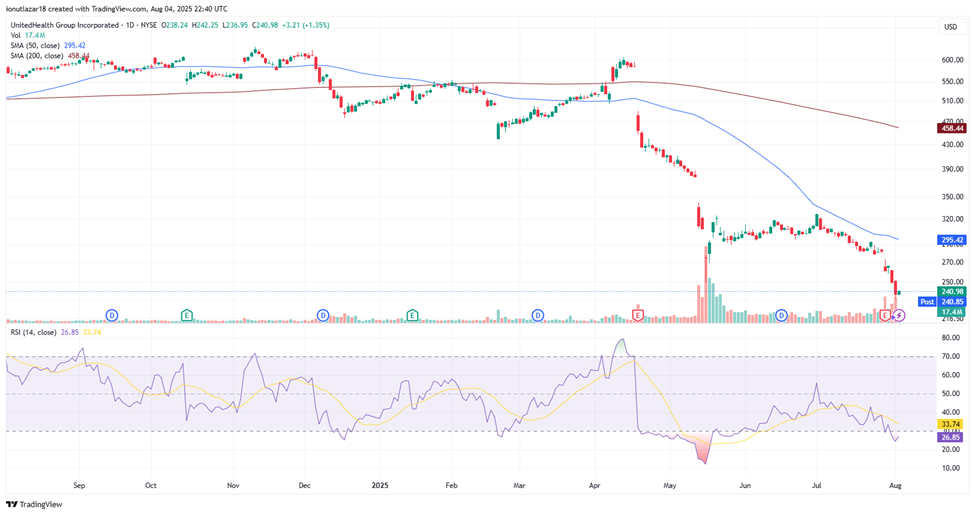
For UnitedHealth Group (UNH), the stock experienced a sharp decline following its Q2 earnings release, dropping -9.3% over the last five days, before showing only a minor rebound at the start of this week with a +1.35% gain. Despite the slight recovery, the overall trend remains heavily bearish, with the stock down -52.23% year-to-date, reflecting sustained investor concerns. Technically, UNH is trading far below both its 50-day SMA ($296.42) and 200-day SMA ($458.44), emphasizing a strong downward momentum. The RSI (14) at ~26.85 signals the stock is deep in oversold territory, yet buyers remain hesitant given the persistent downtrend and significant pressure on the company’s market outlook.
Author: Ionuț-Adrian Lazar