Volkswagen Group delivers resilient performance amid global challenges in Q2 2025

Overview
Volkswagen Group delivered a solid second-quarter performance despite facing significant macroeconomic and regulatory headwinds, including U.S. tariffs and one-time restructuring expenses. While vehicle deliveries remained stable and demand in key European markets improved, earnings were impacted by cost factors and strategic investments. The Group remains focused on improving efficiency and executing its long-term electrification and digitalization strategy.
Oliver Blume, CEO of Volkswagen AG, stated: “Driven by the success of our new products, Volkswagen Group held its ground in an extremely challenging environment. We made noticeable improvements in design, technology, and quality, and achieved significant progress in software. Our sales figures remain stable in a competitive global market. In Europe we expanded our leading position in electric mobility, with a market share of 28 percent and order books remain well filled. Supported by our ongoing product offensive and consistently good demand, we expect the positive trend to continue in second half of the year.”
Q2 2025 vs. Q2 2024:
- Sales revenue reached €80.81bn (-3% YoY), primarily due to negative currency effects, despite stable vehicle deliveries and growth in financial services.
- Operating profit fell to €3.83bn (-29% YoY), reflecting approximately €2bn in one-time effects from U.S. tariffs, CO₂ penalties, and brand restructuring.
- Operating margin decreased to 4.7%, compared to 6.5% in Q2 2024.
- Net income declined to €2.29bn (-36% YoY), while earnings before tax totaled €3.31bn, down from €4.93bn last year.
- Operating cash flow in the Automotive Division was €5.71bn (down from €9.0bn), impacted by working capital needs, tariffs, and higher investments.
- Net cash flow turned negative at €523m, due to restructuring, the €0.9bn investment in Rivian, and tariff-related outflows.
- Net liquidity in the Automotive Division stood at €28.39bn, slightly below the H1 2024 level.
- Group vehicle deliveries totaled 2.26m units in Q2 and 4.36m in H1 2025, with growth in South America and a 19% YoY increase in Western Europe order intake.
- Brand Group Core achieved a 4.8% operating margin, supported by ongoing efficiency gains at VW Passenger Cars and strong performance from Škoda, which posted a record €740m operating result and 8.5% margin.
- Brand Group Progressive reported €1.1bn in operating profit, with a 3.3% margin, weighed by model changeovers, regulatory compliance costs, and U.S. tariffs.
- Sport Luxury (Porsche Group) sales volume declined to 135,000 units (-11% YoY), with revenue down to €16.1bn (-9% YoY). Operating profit fell to €832m, impacted by battery cost inflation, higher tariffs, and strategic investment outlays.
- TRATON Commercial Vehicles reported €21.2bn in revenue (-7% YoY), and a 39% decline in operating profit to €1.2bn, due to soft demand in North and South America and Europe.
- CARIAD (Software Division) revenue increased nearly 30% YoY, but posted an operating loss of €1.17bn (flat versus last year). Excluding restructuring, the loss narrowed by €200m, reflecting progress in cost reduction.
- Volkswagen Group Mobility delivered a strong quarter with €1.8bn in operating profit, driven by higher contract volumes and improved profitability across leasing and financial services.
Volkswagen updated its 2025 full-year guidance to reflect external headwinds and internal adjustments tied to tariffs and restructuring. The Group now expects full-year revenue to remain flat versus 2024 (previously: +5% growth). The operating return on sales is forecasted between 4.0-5.0%, revised down from 5.5-6.5%. Automotive net cash flow is now projected at €1bn-€3bn, compared to €2bn-€5bn previously, as cost pressures weigh on free cash generation. Net liquidity in the Automotive Division is expected between €31-€33bn (prior: €34bn-€37bn), assuming current U.S. tariffs remain at 27.5%. The company notes continued risks from geopolitical tensions, emissions regulations, competitive pricing pressures, and supply chain volatility.
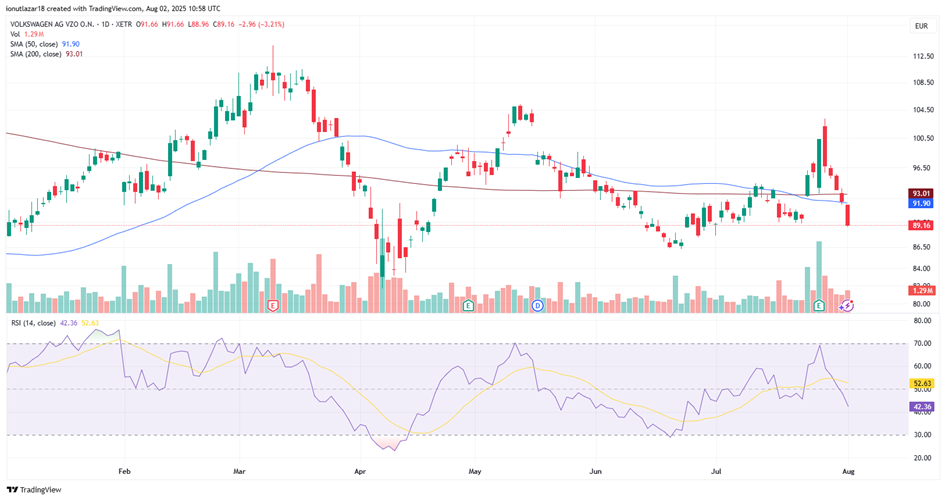
Volkswagen shares initially reacted positively after the Q2 2025 earnings release on July 25, but momentum quickly reversed. Over the past five trading days, the stock has dropped by -12.76%. On the daily chart, the price broke below key support levels and is now trading under both the 50-day SMA and 200-day SMA, signaling strong selling pressure. The elevated trading volume in recent sessions reflects significant distribution and a bearish short-term sentiment. The RSI (14) has fallen to 42.56, approaching oversold territory, which could indicate a potential short-term stabilization if buyers step in around the €88-€89 support zone. A failure to hold this level might extend the correction toward €85. For a recovery and a return to a bullish bias, the stock would need to reclaim €92-€93 and establish support above the moving averages.
Author: Ionuț-Adrian Lazar