
Walmart delivers $165.6bn revenue and expands operating margins in Q1

Overview
Walmart began the fiscal year with steady growth and expanding profitability, driven by strong performance in U.S. grocery, health & wellness, and a continued surge in global eCommerce and advertising.
CEO Doug McMillon noted: “We delivered a solid first quarter in a dynamic operating environment. We’re serving customers and members in more ways, which is fueling our growth. We’re well positioned, maintaining flexibility to navigate the near-term while continuing to invest to create value for the long-term.”
Q1 FY2026 vs. Q1 FY2025:
- Total revenues increased to $165.6bn (+2.5% YoY), with strength in U.S. comp sales and eCommerce, but with FX headwind of ~240 bps.
- Global eCommerce sales grew +22% YoY, led by store fulfilled pickup & delivery and marketplace.
- Walmart U.S. net sales recorded a value of $112.2bn (+3.2% YoY), with comp sales (ex-fuel) up +4.5% YoY, led by grocery and health & wellness. eCommerce sales grew +21% YoY, contributing ~350 bps to comp growth.
- Sam’s Club U.S. net sales were $19.7bn (+5.5% YoY), with comp sales (ex-fuel) up +6.7% YoY, led by food, health & wellness, and rising transaction volumes. eCommerce Sales rose +27% YoY, with delivery growth of ~160%.
- Walmart International net sales (cc) were $32.1bn (+7.8% YoY), a growth led by China, Flipkart, and Walmex. eCommerce Sales increased +20% YoY, with digital mix up in all markets.
- Operating income increased to $7.14bn (+4.3% YoY), while adjusted operating income (cc) also grew +3.0% YoY, supported by higher gross margins (+12 bps) and membership income.
- Walmart U.S. operating income recorded a value of $5.7bn (+7.0% YoY), driven by improved eCommerce economics, business mix, and higher membership income.
- Sam’s Club U.S. operating income was $686m (+11.5% YoY), supported by growing membership income (+9.6% YoY) and general merchandise recovery.
- Walmart International operating income (cc) declined to $1.4bn (-6.4% YoY), impacted by strategic growth investments and currency translation.
- Adjusted EPS was flat at $0.61 (vs. $0.60 in Q1 FY2025), excluding $0.05/share net loss from equity and other investments.
- Free cash flow recorded a value of $425m (+~$850m YoY), while operating cash flow increased to $5.4bn (+29% YoY), partially offset by increased capex to $5.0bn (+7% YoY), which supporting store remodels and tech infrastructure.
- ROI recorded a value of 15.3% (+30 bps YoY).
- Walmart ended the quarter with $9.3bn in cash and $52.9bn in total debt.
- The company repurchased 50.4m shares bought back for $4.6bn.
For fiscal year 2026, Walmart reaffirmed its full-year guidance, expecting constant currency net sales growth of 3.0% to 4.0% and adjusted operating income growth between 3.5% and 5.5%. Adjusted EPS is projected to range from $2.50 to $2.60, while capital expenditures are expected to be approximately 3.0% to 3.5% of net sales, reflecting continued investment in technology, supply chain, and store enhancements. For Q2 specifically, the company anticipates 3.5% to 4.5% sales growth in constant currency, supported by the recently closed VIZIO acquisition. Despite FX headwinds and leap year effects, Walmart remains confident in its ability to deliver solid results across its diverse global business.
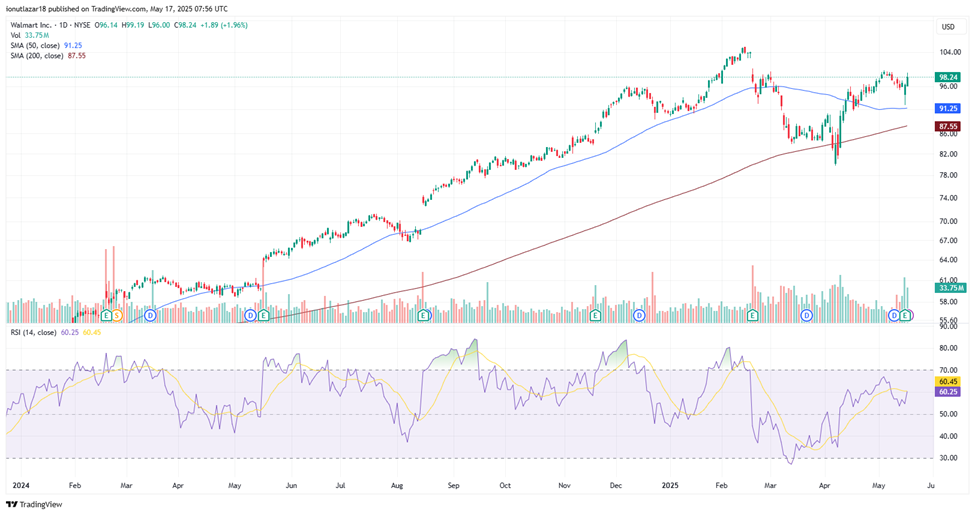
The quarterly results report above Wall Street analysts’ expectations brought an increase in the stock price of WMT shares by almost +2% at the end of the trading week, which keeps the price on an upward trend since the beginning of this year, by over +9%, despite the uncertainties that persisted especially in April regarding customs tariffs. The publication of the report supported a continuation of the technical recovery for Walmart, consolidating the price above the 50-day moving average. From a technical perspective, the stock is in a stability zone, with a favorable configuration for buyers in the medium term. The RSI supports the possibility of a continuation of the upward trend, and staying above the psychological threshold of $95 could allow testing the previous highs (~$104). However, it is recommended to monitor the volume and price reaction in the $100-$104 area, which can act as resistance.
Author: Ionuț-Adrian Lazar