Tesla sees profit drop and cash flow turns positive in Q1 2025

Overview
Tesla’s Q1 2025 results reflected a transitional period marked by lower vehicle deliveries, production line upgrades, and ongoing investments in AI, energy, and autonomous technologies. While profitability was significantly down year-over-year, Tesla maintained positive cash flow and highlighted key progress in AI infrastructure, energy storage, and operational automation.
In Q1 2025, Tesla achieved a significant operational milestone by simultaneously upgrading production lines across all factories for the world’s best-selling vehicle – the Model Y – without major disruptions. This unprecedented transition, combined with continued investment in AI infrastructure and energy storage technology, underscores Tesla’s focus on long-term innovation and resilience. As the company navigates growing macroeconomic and geopolitical uncertainties, it remains committed to delivering affordable, high-value products while maintaining a strong financial position and advancing its autonomous and energy-driven vision for the future.
Q1 2025 vs. Q1 2024:
- Total revenue declined to $19.3bn (-9% YoY), driven by lower vehicle deliveries and reduced average selling prices.
- Automotive revenue decreased to $14bn (-20% YoY), due to due to production and delivery disruptions from the Model Y upgrade across all factories, lower ASPs (excluding FX), affected by mix and sales incentives and FX headwinds (~$300m impact).
- Energy business revenue grew to $2.73bn (+67% YoY), driven by driven by Powerwall deployments surpassed 1 GWh for the first time, Shanghai Megafactory produced >100 Megapacks, preparing for global delivery and energy gross margin improved sequentially.
- Services and other revenue rose to $2.64bn (+15% YoY), supported by 25% YoY growth in gross profit from non-warranty service and collision repairs and supercharger network expanded 17% YoY, with 1.4 TWh of electricity delivered (+26% YoY).
- Total production also declined to 362,615 (-16% YoY), while total deliveries were also on a downward slope, reaching the value of 336,681 (-13% YoY).
- GAAP net income fell sharply to $409m (-71% YoY), while non-GAAP net income also decreased to a value of $934m (-39% YoY).
- In the same way, GAAP EPS recorded a value of $0.12 (compared to $0.41 in Q1 2024), while non-GAAP EPS was $0.27 (vs. $0.45 in Q1 2024).
- Operating expenses increased to $2.75bn (+9% YoY) due to higher R&D investments, especially in AI and autonomy (e.g., Optimus bot, FSD, Robotaxi).
- Operating margin recorded a value of 2.1% (-343bps YoY).
- Adjusted EBITDA declined to $2.81bn (-17% YoY), with adjusted EBITDA margin of 14.6% (-133bps YoY).
- Free cash flow increased to $664m (compared to -$2.5bn in Q1 2024), while operating cash flow recorded a value of $2.16bn (vs. $242m in Q1 2024).
- Cash & investments were $37.0bn (+$0.4bn QoQ), ensuring flexibility for roadmap and capacity expansion.
- Tesla launched FSD (Supervised) in China and plans for rollout in Europe (pending regulatory approval).
- Autonomous driving from factory line to outbound lots now live for Model 3/Y and Cybertruck in the U.S.
- Gigafactory Texas produced its 400,000th vehicle, including the new Long Range Cybertruck.
Tesla will revisit its 2025 guidance in Q2 due to global macro uncertainty and evolving trade policy. While volume growth depends on factors like autonomy acceleration and factory ramping, Tesla remains committed to producing more affordable models, scaling AI-driven services, and maximizing factory utilization. Hardware margins may remain under pressure, but software and fleet-based profits are expected to rise in the long term.
Even though the main results reported for this quarter were below Wall Street analysts’ estimates, TSLA’s share price saw a fairly significant appreciation in pre-market trading, and at the time of writing this article, it increased by over +6% in less than 24 hours. Even so, since the beginning of this year, TSLA’s stock price has seen a huge decrease, by over -37%, after CEO Elon Musk’s obvious rapprochement with President Donald Trump, trading below the 50-day moving average since the end of January, which leaves some question marks regarding the company’s near future.
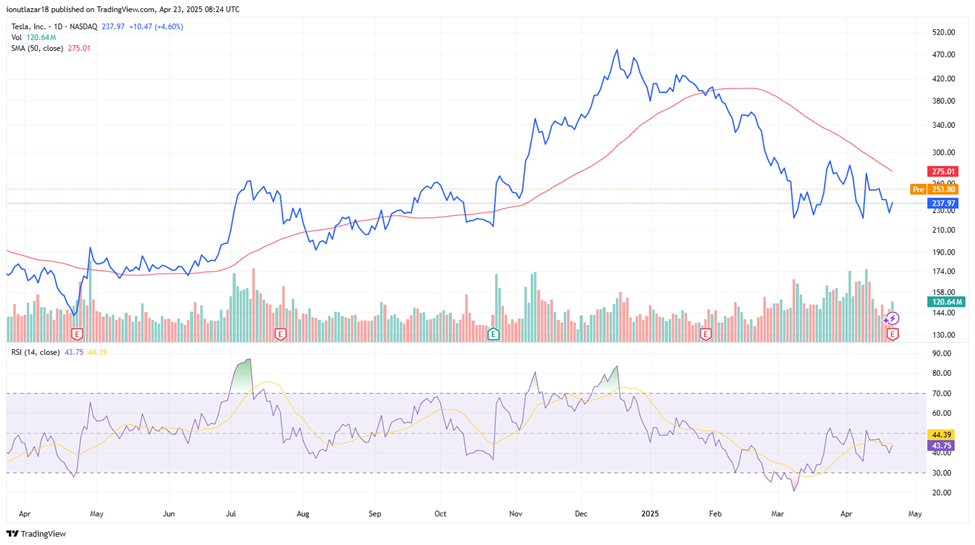
Author: Ionuț-Adrian Lazar
Discover more from FSEGA Investment Club
Subscribe to get the latest posts sent to your email.