
Alibaba’s “User First, AI-Driven” strategy pays off as Fiscal Year ends strong
Overview
Alibaba closed its fiscal year with a solid fourth quarter, marked by accelerating cloud growth, improved profitability, and strong operational execution across its core businesses. The results reflect the continued effectiveness of the company’s “user first, AI-driven” strategy, with fiscal year-end metrics showing significant year-over-year gains in operating income, adjusted EBITA, and net income.
CEO Eddie Wu said: “Our results this quarter and for the full fiscal year demonstrate the ongoing effectiveness of our ‘user first, AI-driven’ strategy, with core business growth continuing to accelerate. Driven by strong demand for AI, Cloud Intelligence Group quarterly revenue growth accelerated to 18%, with AI-related product revenue achieving triple-digit growth for the seventh consecutive quarter. Customer management revenue at Taobao and Tmall Group grew 12% this quarter, reflecting the sustained impact of investments in user experience and effective monetization. Looking ahead, we will remain focused on our core businesses and continue to drive AI + Cloud as a new engine for our long-term growth.”
Q4 FY2025 vs. Q4 FY2024:
- Revenue was RMB236.4bn or $32.6bn (+7% YoY), driven by broad-based growth across core commerce and cloud segments.
- Taobao and Tmall Group revenue was up +8% YoY, with customer management revenue rose +12% YoY, driven by improved take rate and user experience enhancements. EBITA increased +8% YoY, despite elevated investments in technology and services.
- Alibaba International Digital Commerce Group (AIDC) revenue was up +22% YoY, led by AliExpress and Trendyol. Losses narrowed thanks to improved monetization and efficiency, particularly at Lazada.
- Cloud Intelligence Group revenue was up +18% YoY, driven by strong AI product adoption across industries. EBITA surged +69% YoY, reflecting scalable public cloud growth.
- Cainiao Smart Logistics Network Limited (“Cainiao”) revenue was down -12% YoY. This is the result of the increasing integration of logistics offerings into e-commerce businesses.
- Local Services Group revenue was up +10% YoY, led by Amap and Ele.me order growth. EBITA loss narrowed on improved operating scale.
- Digital Media & Entertainment revenue grew +12% YoY, turning EBITA positive due to Youku’s profitability and strong movie business.
- Income from operations rose to RMB28.5bn or $3.9bn (+93% YoY), supported by higher adjusted EBITA and lower share-based compensation.
- Adjusted EBITA recorded a value of RMB32.6bn or $4.5bn (+36% YoY), led by revenue growth and improved operating efficiency.
- Net income grew at a fantastic pace, reaching the value of RMB12.0bn or $1.65bn (+1203% YoY), benefiting from mark-to-market investment gains and lower impairments.
- Non-GAAP net income was RMB29.8bn or $4.1bn (+22% YoY), with diluted EPS of RMB1.57 or $0.22 (+23% YoY).
- Net cash provided by operating activities was RMB27.5bn or $3.8bn (+18% YoY), while free cash flow decreased to RMB3.7bn or $516m (-76% YoY), mainly attributed to the increase in the cloud infrastructure expenditure.
- During the quarter ended March 31, 2025, the company repurchased a total of 51m ordinary shares for a total of $0.6bn.
FY2025 vs. FY2024:
- Total revenue was RMB996.3bn or $137.3bn (+6% YoY), driven by growth across core commerce, international operations, and cloud services.
- Income from operations recorded a value of RMB140.9bn or $19.4bn (+24% YoY), primarily due to the decrease in impairment of intangible assets and goodwill, the decrease in non-cash share-based compensation expense and the increase in adjusted EBITA.
- Adjusted EBITA grew to RMB173.1bn or $23.8bn (+5% YoY), primarily attributable to revenue growth and improved operating efficiency, partly offset by the increase in investments in e-commerce businesses and technology.
- Net income was RMB125.9bn or $17.4bn (+77% YoY), primarily due to the mark-to-market changes from equity investments and the increase in income from operations, partly offset by the losses arising from the disposal of subsidiaries.
- Non-GAAP net income remained stable YoY at a value of RMB158.1bn or $21.8bn, while diluted EPS was RMB8.18 or $1.13 (+5% YoY).
- Net cash provided by operating activities was RMB163.5bn or $22.5bn (-10% YoY). Free cash flow also declined to RMB73.9bn or $10.2bn (-53% YoY), which was mainly attributed to the increase in the cloud infrastructure expenditure, partly offset by year-over-year increase of adjusted EBITDA.
- For the fiscal year ended March 31, 2025, the company repurchased a total of 1,197m ordinary shares for a total of $11.9bn, resulting in a net decrease of 995m ordinary shares, or a 5.1% net reduction in the outstanding shares after accounting for shares issued under their ESOP.
- The company had dividends of $2.00 per ADS ($1.05 regular + $0.95 special dividend).
While Alibaba did not issue specific forward guidance, management reiterated its strategic commitment to strengthening core businesses, expanding global commerce, and leading in cloud and AI. With accelerating adoption of its Qwen3 AI models, open-sourcing efforts, and a disciplined investment approach, Alibaba positions itself for sustained growth and innovation in FY2026.
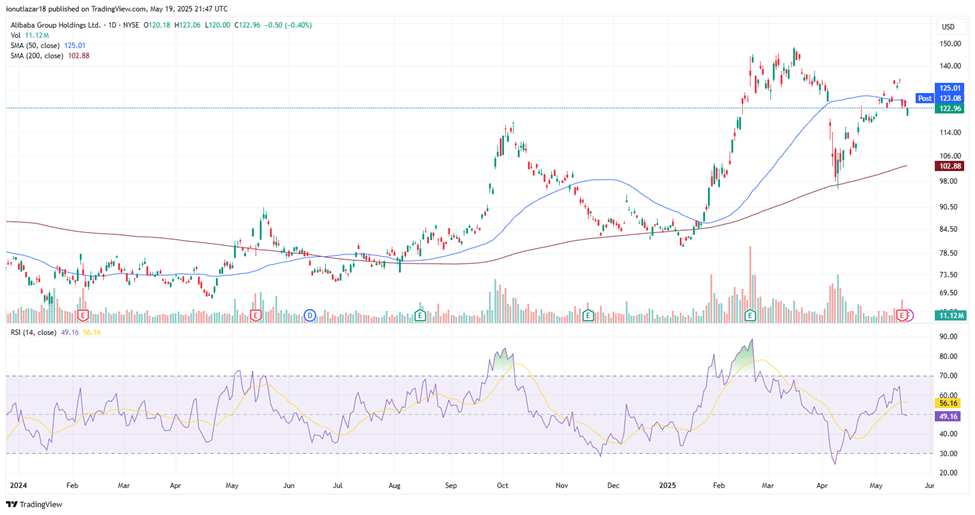
After publishing financial results slightly below analysts’ expectations, BABA stock reacted relatively stably, remaining in a consolidation range between the 50- and 200-day moving averages. However, the stock price decline in the last trading week exceeded the -6% threshold, but since the beginning of the year, the stock is still on a strong upward trend, with an appreciation of over +44%, surprising considering the tensions between the US and China. This positioning reflects a state of uncertainty in the short term. To confirm a clear direction, either a convincing breakthrough above $125 will be necessary, which would signal the resumption of the upward trend, or a return below $110, which would invalidate the recovery structure from April. Neutral RSI suggests that the market is waiting for a new catalyst for direction.
Author: Ionuț-Adrian Lazar