
Intel reports challenging Q2 2025 amid restructuring and margin pressure
Overview
Intel delivered a mixed second-quarter performance as it continues executing a broad restructuring strategy aimed at streamlining operations and restoring long-term profitability. While core revenue held steady and key segments like Data Center and Foundry showed growth, earnings were significantly impacted by one-time charges, impairments, and gross margin compression.
“Our operating performance demonstrates the initial progress we are making to improve our execution and drive greater efficiency. We are laser-focused on strengthening our core product portfolio and our AI roadmap to better serve customers. We are also taking the actions needed to build a more financially disciplined foundry. It’s going to take time, but we see clear opportunities to enhance our competitive position, improve our profitability and create long-term shareholder value”, said Lip-Bu Tan, Intel CEO.
Q2 2025 vs. Q2 2024:
- Revenue totaled $12.9bn (unchanged from Q2 2024), reflecting strength in Data Center and Foundry offset by modest declines in Client Computing.
- Client Computing Group (CCG) revenue declined to $7.9bn (-3% YoY), due to softness in PC demand and pricing pressure across the consumer segment.
- Data Center and AI (DCAI) revenue grew $3.9bn (+4% YoY), reflecting increased adoption of Xeon processors and growth in AI workloads.
- Intel Foundry revenue increased to $4.4bn (+3% YoY), driven by higher external foundry engagements and internal capacity ramp.
- All other revenue reached $1.1bn (+20% YoY), supported by Mobileye and emerging growth businesses.
- GAAP net loss was $(0.67) per share, compared to a loss of $(0.38) in Q2 2024, largely due to restructuring and impairment charges.
- Non-GAAP EPS was $(0.10), down from $0.02 a year earlier, driven by lower gross margins and higher costs tied to business transformation.
- Gross margin declined to 27.5% (GAAP) and 29.7% (non-GAAP), versus 35.4% and 38.7%, respectively, reflecting cost inefficiencies, non-cash impairments, and accelerated depreciation.
- Operating margin was (24.7%) GAAP and (3.9%) non-GAAP, both impacted by workforce reduction charges and manufacturing consolidation.
- Operating cash flow was $2.1bn, while adjusted free cash flow was negative $(1.05)bn, reflecting high capital investments and one-time restructuring costs.
Intel provided Q3 2025 guidance reflecting modest seasonal improvement and continued restructuring execution. The company expects revenue between $12.6bn and $13.6bn and non-GAAP EPS of $0.00, with a projected non-GAAP gross margin of 36.0%. Intel completed most of its workforce reductions, targeting an end-of-year headcount of ~75,000, and incurred $1.9bn in restructuring charges, including severance and facility closures. The company scaled back large capital projects, including delays in Ohio, Germany, and Poland, to optimize cash deployment and improve returns. Intel also sold 57.5m shares of Mobileye, generating $922m in cash during the quarter.
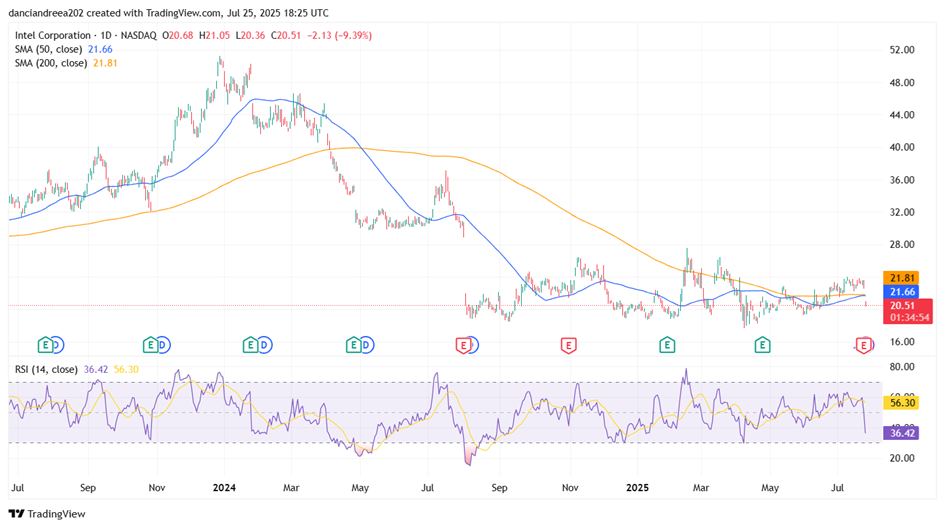
Intel closed down sharply by -9.39% following its Q2 earnings release, breaking below both its 50-day and 200-day moving averages, signaling a clear bearish breakdown. The stock had been consolidating near resistance around the $22 mark, but today’s selloff confirms renewed downward momentum. The RSI (14) has dropped to 36.42, nearing oversold territory, though not yet extreme, leaving room for further downside. Overall, the technical picture is weak, with support levels likely near $19.50-$20.00, and resistance now forming at the moving average cluster around $21.70. Caution is warranted while the trend remains under pressure.
Author: Andreea-Roxana Danci