
Robust wireless and fiber subscriber growth, improved capital efficiency, and disciplined cost control drive profitability for AT&T in second-quarter

Overivew
AT&T delivered a solid second-quarter performance, driven by high-quality subscriber additions in wireless and fiber, better-than-expected free cash flow, and ongoing transformation of its network and cost structure. The company continues to focus on profitable growth through converged connectivity, efficient capital allocation, and simplification of its service portfolio.
CEO John Stankey commented: “We are winning in a highly competitive marketplace, with the nation’s largest wireless and fiber networks. Customers are increasingly choosing AT&T because we have the best technology and options for wireless and broadband connectivity, backed by the AT&T Guarantee. The milestones achieved this quarter – from passing more than 30 million customer locations with fiber and eclipsing 1 million total AT&T Internet Air customers, to our agreement to acquire substantially all of Lumen’s Mass Markets fiber business – strengthen the industry’s best and leading connectivity portfolio”.
Q2 2025 vs. Q2 2024:
- Revenues reached $30.8bn (+3.36% YoY), largely driven by strong growth in Mobility (device sales and subscriber additions) and continued momentum in Consumer Wireline, particularly fiber broadband.
- Mobility revenue increased to $21.8bn (+6.7% YoY), with equipment revenue up 18.8% due to higher smartphone sales and improved upgrade cycles. Service revenue grew 3.5%, driven by postpaid subscriber growth and stable ARPU. EBITDA rose to $9.5bn (+3.2% YoY), supported by scale efficiencies, while churn remained low at 0.87%, reflecting strong customer retention. 401,000 net postpaid phone adds demonstrate continued strength in subscriber acquisition, especially in premium unlimited plans.
- Business Wireline revenue declined to $4.3bn (-9.3% YoY), due to ongoing erosion in legacy copper-based services and pricing pressure in IP-based connectivity. EBITDA fell to $1.32bn (-11.3% YoY), while the unit reported an operating loss of $201m, continuing the structural headwinds seen across the industry.
- Consumer Wireline revenue increased to $3.5bn (+5.8% YoY), mainly from strong fiber broadband growth. Fiber broadband revenue rose 18.9%, driven by 243,000 fiber net adds and pricing improvements. Broadband ARPU rose 7.5%, as customers shifted to higher-speed tiers. EBITDA grew to $1.3bn (+17.8% YoY), reflecting better customer mix and lower acquisition costs.
- Latin America revenue declined to $1.05bn (-4.4% YoY), largely due to foreign exchange pressure, but EBITDA rose to $201m (+12.9% YoY), reflecting improved cost control and postpaid subscriber growth. Net wireless adds totaled 235,000, including 183,000 postpaid, driven by regional demand recovery.
- Operating expenses were $24.3bn (+1.25% YoY), primarily due to higher equipment costs associated with higher wireless equipment revenues, and higher network-related costs.
- Net income increased to $4.9bn (+25.6% YoY), due to improved operational earnings and lower interest expense.
- Diluted EPS was $0.62 (compared to $0.49 last year), while adjusted EPS improved to $0.54 (up from $0.51), reflecting cost control and higher EBITDA contribution from Consumer Wireline.
- Adjusted EBITDA rose to $11.7bn (+3.54% YoY), supported by higher Mobility and Consumer Wireline performance, partially offset by weakness in Business Wireline.
- Free cash flow, which excludes cash flows from DIRECTV, increased to $4.4bn (up from $4.0bn), driven by improved working capital management.
- Cash from operations totaled $9.8bn, reflecting operational growth and higher distributions from DIRECTV, partially offset by higher cash tax payments.
- Capital expenditures were $4.9bn, slightly higher than Q2 2024, but reflecting more efficient investment pacing.
- AT&T completed a $1.0bn share repurchase and finalized the sale of its remaining 70% stake in DIRECTV, contributing to balance sheet simplification and shareholder value return.
AT&T updated its full-year 2025 guidance to reflect strong first-half execution and expected benefits from the One Big Beautiful Bill Act, projected to yield $6.5bn to $8.0bn in tax savings through 2027, which will fund expanded fiber deployment and pension obligations. For full-year 2025, AT&T expects low-single-digit growth in consolidated service revenue, with Mobility service revenue projected to increase by 3% or more, supported by subscriber growth and pricing discipline. Consumer fiber broadband revenue is expected to grow in the mid-to-high teens, reflecting continued adoption of higher-speed tiers and rising average revenue per user (ARPU). The company anticipates adjusted EBITDA growth of at least 3%, along with adjusted earnings per share in the range of $1.97 to $2.07. AT&T plans capital investments totaling $22bn to $22.5bn, primarily directed toward the expansion of its 5G and fiber networks. Free cash flow is forecasted between $16.0bn and $16.5bn, supported by disciplined capital spending and improved operating leverage. AT&T also plans to return $4bn to shareholders through share repurchases, with $1.3bn already completed by mid-year. Looking ahead, the company targets 50m fiber locations passed by 2030, which includes buildout from the recently announced Lumen asset acquisition and other strategic partnerships. AT&T also aims to generate over $19bn in free cash flow by 2027, along with double-digit adjusted EPS growth in that year.
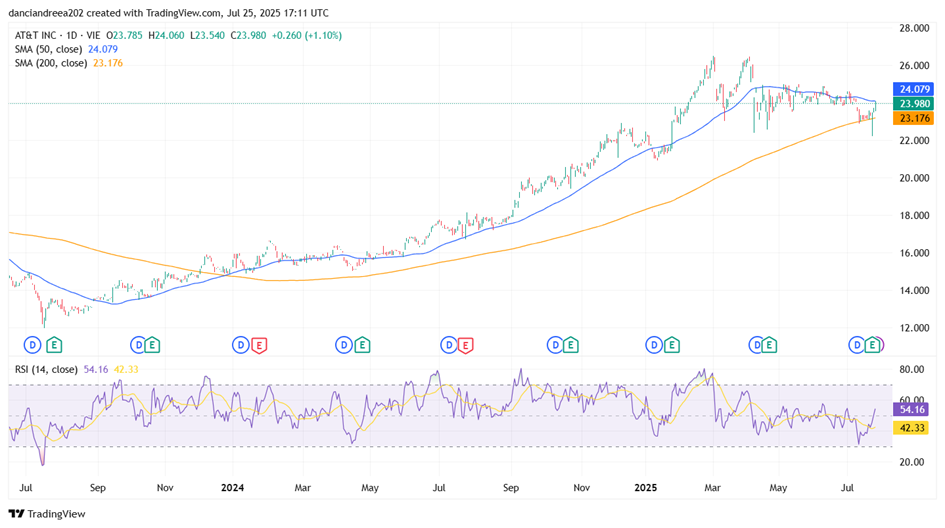
From a technical standpoint, AT&T shares are currently trading slightly below the 50-day moving average, but above the 200-day moving average, suggesting a neutral-to-cautiously bullish setup. The RSI (14) sits at 54.16, indicating modest upward momentum without being overbought. The price recently bounced off the 200-day SMA, which is acting as a key support level. A breakout above the 50-day SMA could signal a potential return to the uptrend.
Author: Andreea-Roxana Danci