Strong Cloud and Infrastructure growth, while RPO explodes over 350% for Oracle in Q1 FY2026

Overview
Oracle kicked off fiscal year 2026 with a standout first quarter. Revenue rose 12% YoY (11% in constant currency) driven by strong performance in cloud infrastructure and SaaS, while Remaining Performance Obligations (RPO) surged dramatically. Though GAAP metrics were mixed, non-GAAP results reflected solid gains, especially in cloud and recurring revenue as Oracle leans further into AI and customer-contracted backlog.
“We signed four multi-billion-dollar contracts with three different customers in Q1. This resulted in RPO contract backlog increasing 359% to $455 billion. It was an astonishing quarter—and demand for Oracle Cloud Infrastructure continues to build. Over the next few months, we expect to sign-up several additional multi-billion-dollar customers and RPO is likely to exceed half-a-trillion dollars. The scale of our recent RPO growth enables us to make a large upward revision to the Cloud Infrastructure portion of Oracle’s overall financial plan which we will be presenting in detail next month at the Financial Analyst Meeting. As a bit of a preview, we expect Oracle Cloud Infrastructure revenue to grow 77% to $18 billion this fiscal year—and then increase to $32 billion, $73 billion, $114 billion, and $144 billion over the subsequent four years. Most of the revenue in this 5-year forecast is already booked in our reported RPO. Oracle is off to a brilliant start to FY26”, said Oracle CEO, Safra Catz.
Q1 FY2026 vs. Q1 FY2025:
- Total revenue was $14.9bn (+12% YoY in USD and +11% in constant currency), driven by strength in cloud offerings.
- Cloud revenue (IaaS + SaaS) reached $7.2bn (+28% YoY in USD and +27% in constant currency), showing accelerated adoption of Oracle’s cloud stack.
- Cloud Infrastructure (IaaS) revenue was $3.3bn (+55% YoY and +54% in constant currency), reflecting strong demand for infrastructure compute and storage services.
- Cloud Applications (SaaS) revenue was $3.8bn (+11% YoY and +10% in constant currency), including growth in Fusion ERP and NetSuite ERP, each around $1.0bn.
- Software revenue (excluding cloud) declined slightly: -1% YoY in USD and -2% in constant currency, reflecting transitions away from older license models.
- Cloud revenue (IaaS + SaaS) reached $7.2bn (+28% YoY in USD and +27% in constant currency), showing accelerated adoption of Oracle’s cloud stack.
- GAAP operating income was $4.3bn (+7% YoY), while non-GAAP operating income was $6.2bn (+9% YoY in USD and +7% in constant currency), indicating operating leverage once adjustments are excluded.
- Operating expenses rose to $10.65bn (+14% YoY and ≈71% of revenue), driven by higher spending in cloud & software, R&D, and restructuring expenses.
- GAAP net income was $2.9bn (essentially flat YoY), while non-GAAP net income rose to $4.3bn (+8% YoY in USD and +6% in constant currency), showing improved profitability on adjusted basis.
- GAAP EPS came in at $1.01 (-2% YoY), but non-GAAP EPS was $1.47 (+6% YoY in USD and +4% in constant currency), reflecting favorable impact of non-GAAP adjustments.
- Remaining Performance Obligations (RPO) jumped 359% YoY to $455bn, showing strong backlog and contracted future revenue.
Oracle expects demand in its Cloud Infrastructure business to continue accelerating: the company previewed plans to grow OCI revenue by ~77% this fiscal year to about $18bn. With the strong RPO backlog, Oracle is projecting further gains in multi-cloud and AI database offerings. While short-term GAAP metrics may face pressure from investments and restructuring costs, the non-GAAP view points to durable growth in cloud subscription, infrastructure, and ERP SaaS segments. The company also declared a quarterly cash dividend of $0.50 per share.
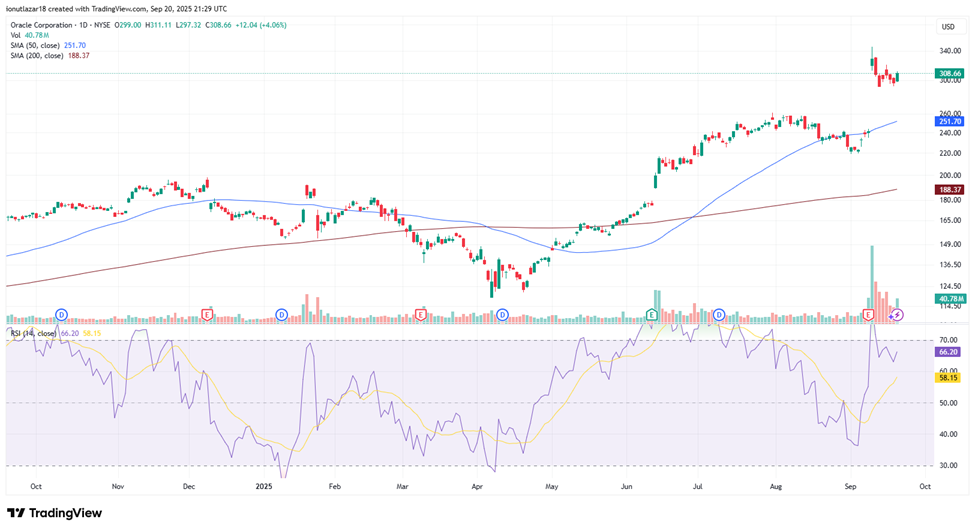
Oracle shares skyrocketed nearly +36% in a single session following the latest earnings release, fueled by strong results and renewed investor enthusiasm around AI. As expected, the move was followed by a mild correction in subsequent trading sessions, a normal reaction after such an extreme rally. Even so, the stock remains close to all-time highs, consolidating gains at elevated levels. The RSI stands at 66.20, still in overbought territory, which could bring short-term volatility, but the medium-term outlook remains strongly bullish. The 50-day SMA ($251.70), recently broken to the upside, is now likely to act as a key support level in the weeks ahead, reinforcing the positive technical setup.
Author: Ionuț-Adrian Lazar