
TSMC posts record Q2 earnings on AI demand and raises 2025 outlook

Overview
Taiwan Semiconductor Manufacturing Company (TSMC), the world’s leading contract chipmaker, reported a record performance for the second quarter of 2025, fueled by robust demand in AI and high-performance computing (HPC). The company delivered strong revenue and profit growth and raised its full-year outlook as advanced technology adoption accelerated.
“Our second-quarter performance reflects strong execution and increasing customer demand for our leading-edge technologies. […] With 3nm adoption gaining traction and continued strength in AI-related platforms, we expect momentum to build further in the second half of the year”, said Wendell Huang, TSMC’s Senior VP and Chief Financial Officer.
Q2 2025 vs. Q2 2024:
- Net revenue reached NT$933.79bn (≈US$30.07bn), marking a +38.6% YoY and +11.3% QoQ increase, led by higher content in HPC and smartphone chips.
- Gross margin improved to 58.6%, up from 53.2% in Q2 2024, primarily due to favorable product mix, cost efficiencies and scale.
- Operating income rose to NT$463.42bn (+61.7% YoY), with an operating margin of 49.6%, driven by a rise in 3nm output, enhanced fab utilization, and lower depreciation per unit.
- Net income surged +60.7% YoY to NT$398.27bn(≈US$12.bn), translating to NT$15.36 EPS or US$2.47 per ADR.
- Net profit margin reached 42.7%, versus 36.8% in Q2 2024.
- Total operating expenses rose slightly to NT$70.37bn (+1.7% YoY).
- R&D expenses were NT$62.58bn (+5.3% YoY), reflecting increased investment in 2nm and A14 node development, offset by program completion in mature technologies.
- SG&A costs declined to NT$7.78bn (-12.6% YoY), due to optimization of sales activities in China and streamlined logistics in global supply chains.
- Advanced nodes (7nm and below) made up 74% of wafer revenue, up from 65% in Q2 2024.
- 3nm share expanded to 24% of total revenue (vs. 15% in Q1), reflecting major ramps for mobile SoCs and AI inference chips.
- 5nm remained the largest node at 36%, supporting premium smartphones and cloud accelerators.
- 7nm contributed 14%, with stable volume in networking and baseband platforms.
- High-Performance Computing (HPC) contributed 60% of total revenue, up +14% QoQ.
- Smartphones rose to 27% of revenue, growing +7% QoQ, supported by seasonal builds and 3nm adoption.
- Automotive and IoT each comprised 5%, with IoT showing +30% QoQ growth due to edge compute devices.
- Digital Consumer Electronics (DCE) remained flat at 1%, reflecting ongoing softness in TV and camera SoCs.
- Operating cash flow in Q2 was NT$497.07bn, supported by strong net income and stable working capital.
- Free cash flow was NT$199.85bn (-15.3% QoQ), due to higher income tax payments and capex timing.
- Capital expenditures reached US$9.63bn, largely directed toward 3nm expansion in Taiwan and early 2nm investment in Arizona and Japan.
- Cash & equivalents were NT$2.36tn, with net cash reserves of NT$1.66tn.
- Debt decreased to NT$527.57bn, supported by strong cash generation and favorable exchange rate adjustments.
For the third quarter of 2025, TSMC expects revenue to be in the range of US$31.8bn to US$33.0bn, with a gross margin between 55.5% and 57.5% and an operating margin between 45.5% and 47.5%. For the full year, the company forecasts approximately 30% revenue growth in USD terms, driven by a strong ramp-up in 3nm capacity and continued risk production of its 2nm technology. Sustained demand for AI, smartphones, and high-performance computing (HPC) custom silicon remains a key growth driver throughout 2025.
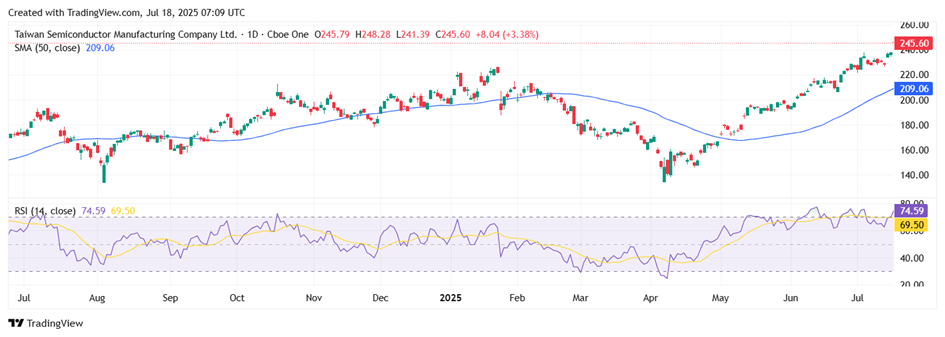
From a technical analysis perspective, TSMC shares have shown significant upside following the release of its Q2 2025 financial results, as evidenced by recent price action and technical indicators. Following the release of the quarterly report, the stock price has remained well above its 50-day simple moving average (SMA), indicating sustained upward momentum. The relative strength index (RSI) was at 74.59, placing the stock in overbought territory, which may signal near-term exhaustion or potential consolidation. However, the strong post-release growth suggests positive investor sentiment, supported by the company’s robust Q3 guidance and full-year outlook.
Author: Andreea-Roxana Danci