Vertex Pharmaceuticals raises slightly 2025 outlook after solid Q1 growth

Overview
Vertex Pharmaceuticals started 2025 with steady revenue growth, expanding therapeutic launches, and rapid clinical pipeline advancement.
CEO Reshma Kewalramani noted: “Vertex delivered a strong start to 2025 with notable execution across the business as we grow and diversify the revenue base, progress multiple launches and advance the R&D pipeline. We continued to expand our leadership in CF and build global momentum for CASGEVY, and we launched JOURNAVX in moderate-to-severe acute pain. With multiple programs in pivotal development including povetacicept, which continues to make rapid progress in achieving its potential as a pipeline-in-a-product, and additional programs in early and mid-stage development, Vertex is poised to continue to deliver value for years to come.”
Q1 2025 vs. Q1 2024:
- Total revenue grew slightly to $2.77bn (+3% YoY), driven by TRIKAFTA/KAFTRIO and the U.S. launch of ALYFTREK.
- In the U.S., total revenue increased to $1.66bn (+9% YoY), due to continued strong patient demand and higher net realized pricing.
- Outside the U.S., total revenue decreased to $1.11bn (-5% YoY) as strong patient demand in both established and newer markets was offset by the expected revenue decline in Russia, where Vertex is experiencing violation of its intellectual property rights.
- Total costs and expenses increased to $2.14bn (+38% YoY), primarily due to continued R&D investment in support of multiple mid- and late-stage clinical development programs and increased commercial investment to support the launch of JOURNAVX.
- GAAP net income declined to $646m (-41% YoY), as a result of increased operating expenses and the intangible asset impairment charge.
- Non-GAAP net income also decreased to $1.05bn (-15% YoY), reflecting higher operating expenses supporting R&D and commercial expansion.
- GAAP effective tax rate was 11.5% (vs. 14.0% in Q1 2024), while non-GAAP effective tax rate was 18.8% (vs. 17.4% in Q1 2024), the difference between the GAAP and non-GAAP effective tax rates was primarily due to tax benefits related to stock-based compensation.
- GAAP EPS was $2.49 (compared to $4.21 in Q1 2024), while non-GAAP EPS was $4.06 (vs. $4.76 in Q1 2024).
- Cash, cash equivalents and total marketable securities as of March 31, 2025, were $11.4bn (compared to $11.2bn as of December 31, 2024), primarily due to cash flows from operating activities, partially offset by repurchases of Vertex’s common stock pursuant to its share repurchase program.
Vertex raised the low end of its FY2025 revenue guidance to $11.85bn-$12.00bn, up from $11.75bn. This outlook reflects continued growth in CF (including ALYFTREK uptake), global rollout of CASGEVY, and early contributions from JOURNAVX. The company maintained its non-GAAP operating expense forecast of $4.9bn-$5.0bn and effective tax rate guidance of 20.5%-21.5%, reinforcing its commitment to pipeline investment and commercial execution.
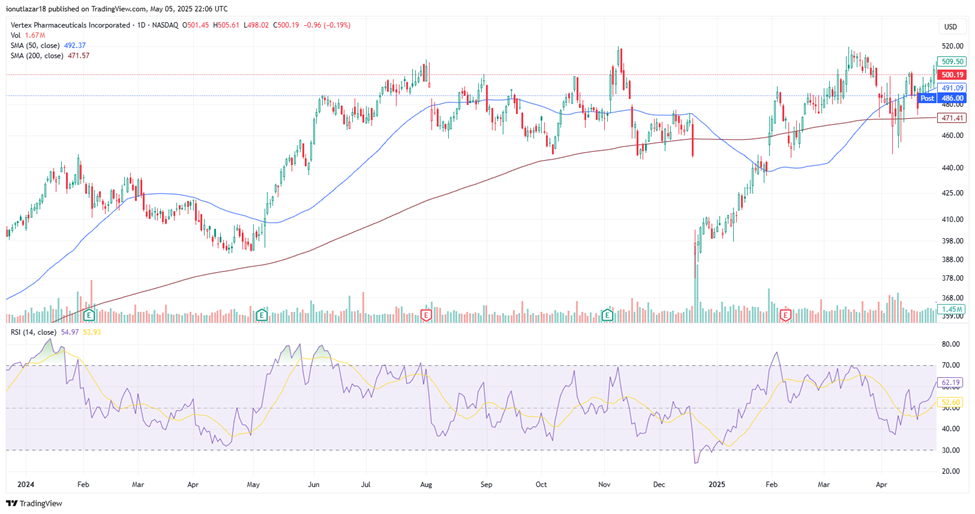
Even though the company’s management slightly raised its guidance for this highly volatile year, the market did not react so well, with VRTX shares down nearly -3% in after-market trading following the quarterly results. However, since the beginning of this year, the share price has been on a fairly strong upward trend, rising by approximately +23% in the first four months, after it collapsed towards the end of 2024. Although the price closed above the 50-day moving average, signaling a potential breakout, the after-market decline calls into question the validity of the resistance break. The RSI indicator remains in neutral territory, and the support offered by the 200-day moving average ($471) remains an important landmark in the event of a correction. The context suggests caution, with possible returns to the lower support of the range.
Author: Ionuț-Adrian Lazar