Autonomy milestone, energy growth and resilient financials despite lower deliveries for Tesla in second-quarter

Overview
Tesla’s Q2 2025 marked a strategic pivot as the company launched its first Robotaxi service and made its first fully autonomous customer delivery. While overall revenue and automotive deliveries were still below 2024 levels, the quarter represented a transition from a purely automotive and energy company to a broader technology and AI platform.
CEO Elon Musk and the Tesla team emphasized their focus on scaling autonomy and AI as the company ramps toward volume production of new, more affordable models and prepares for Cybercab and Semi in 2026. Tesla also expanded its global energy deployments and AI infrastructure significantly, even amid a volatile macroeconomic environment.
Q2 2025 vs. Q2 2024:
- Total revenue declined to $22.5bn (-12% YoY), reflecting lower vehicle deliveries (-13% YoY), reduced average selling prices (ASP) and decline in regulatory credits revenue.
- Automotive revenue also decreased to $16.7bn (-16% YoY), with Model 3/Y deliveries of 373,728 units and other models deliveries of 10,394 units.
- Energy generation and storage revenue recorded a value of $2.8bn (-7% YoY), with megapack deployments from Shanghai factory began and 12th consecutive TTM record in energy storage volumes.
- Services and other revenue was $3.0bn (+17% YoY), reflecting growth in service-related revenue and supercharging profitability.
- GAAP net income fell to $1.17bn (-16% YoY), while non-GAAP net income also decreased to a value of $1.39bn (-23% YoY).
- In the same way, GAAP EPS recorded a value of $0.33 (-18% YoY), while non-GAAP EPS was $0.40 (-23% YoY).
- Operating income decreased to $923m (-42% YoY), with an operating margin of 4.1% (-219bps YoY), but the company had lower cost per vehicle and improved energy margins.
- Operating expenses increased to $2.75bn (+9% YoY) due to higher R&D investments, especially in AI and autonomy (e.g., Optimus bot, FSD, Robotaxi).
- Operating margin recorded a value of 2.1% (-343bps YoY).
- Adjusted EBITDA declined to $3.4bn (-7% YoY), with adjusted EBITDA margin of 15.1% (+71bps YoY).
- Free cash flow declined to $146m (-89% YoY), while operating cash flow recorded a value of $2.54bn (-30% YoY).
- Cash & investments were $36.8bn (flat QoQ), while capital expenditures (CapEx) grew slightly to $2.39bn (+5% YoY).
- Tesla launched in Q2 its first Robotaxi service in Austin with a safety driver, completed its first fully autonomous vehicle delivery, and introduced an app that integrates ride requests, climate control, entertainment, and payment.
- Tesla produced 410,244 vehicles in Q2 (flat YoY), expanded its Supercharging network to 7,377 stations and 70,228 connectors (+18% YoY), and grew services gross profit by 64% quarter-over-quarter.
Tesla reiterated its long-term focus on scaling autonomy through rapid software development and fleet deployment, beginning production of more affordable models in H2 2025, launching Cybercab at scale in 2026, expanding global energy storage capacity to meet rising demand, and growing AI-driven services across both customer and internal applications. Despite ongoing macroeconomic uncertainty, the company expects software and AI-related margin growth to increasingly offset pressure on hardware margins.
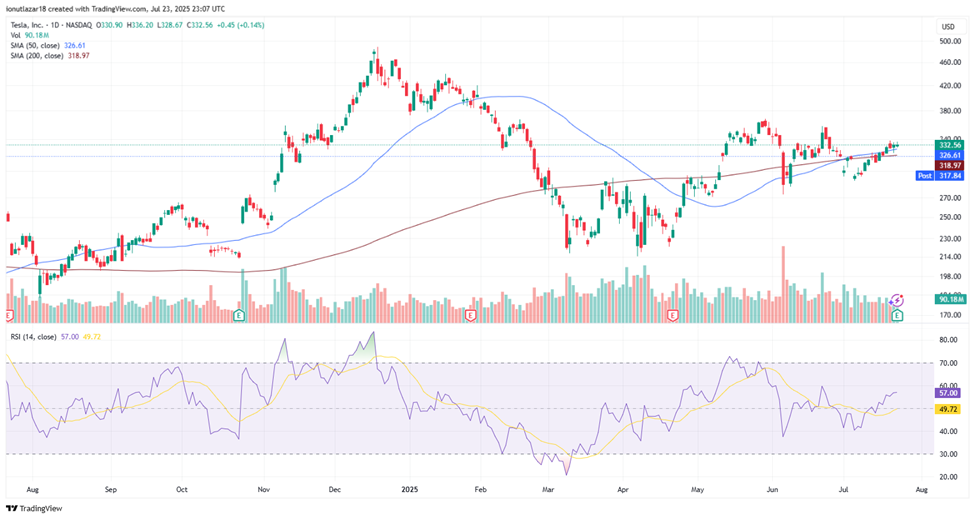
Tesla shares declined sharply in after-hours trading on July 23, falling by over 4% following the release of its Q2 2025 results. This negative reaction reflects investor concerns despite recent technical consolidation near local highs. At the close of the regular session, the stock traded at $332.56, with a notable drop to around $318.40 in the post-market, placing it below both the 50-day and 200-day simple moving averages. Although Tesla had been slowly recovering since late April, the stock remains down over 12% year-to-date, underperforming broader indices and many tech peers. The RSI stood at 57.00 prior to the earnings release, indicating moderate bullish momentum that now risks fading if the selloff persists. A sustained breakdown below the $315-$318 support zone could signal renewed downside risk, while a recovery back above $330 would be essential to reestablish near-term bullish structure.
Author: Ionuț-Adrian Lazar
Discover more from FSEGA Investment Club
Subscribe to get the latest posts sent to your email.